How Distraction Becomes Your Default Mode
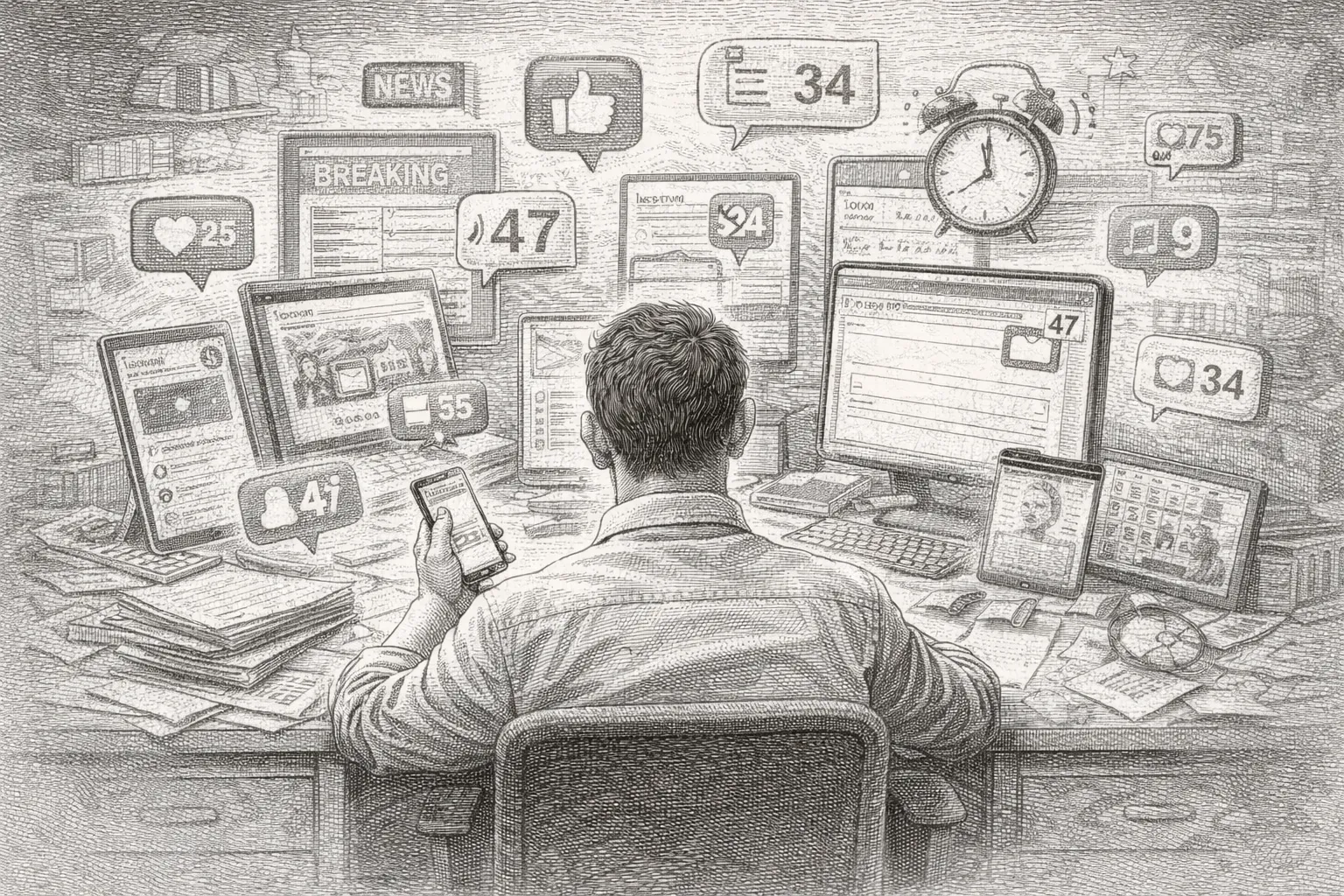
You sit down to work on something important. Within three minutes, you’ve checked your email, glanced at your phone, and opened a new tab to look up something only tangentially related to your task. You didn’t consciously decide to do any of these things—they just happened. Your attention scattered before you realized it was moving. This isn’t a failure of willpower. It’s what your brain has been trained to do.
Distraction isn’t something that happens to you—it’s something your brain has learned to actively seek out because you’ve trained it to.
The Problem
You can remember a time when you could focus for hours. Maybe it was in school, maybe it was early in your career, maybe it was just a few years ago. You could sit down with a book or a project and disappear into it. Your attention stayed where you put it. Distractions existed, but they didn’t have the constant magnetic pull they have now.
Something has changed. Now, sustained focus feels almost impossible. Even when you want to concentrate, even when the task is important and interesting, your mind won’t stay put. It jumps to other things—checking notifications, wondering about unrelated topics, scanning for something more immediately engaging. You’re not choosing this. It’s happening automatically, beneath your conscious awareness.
You tell yourself you’ll focus better tomorrow. You’ll be more disciplined. You’ll resist the urge to check your phone. But tomorrow comes and the same pattern repeats. Because this isn’t about discipline or willpower. Your brain has been fundamentally reshaped by months or years of operating in a state of continuous partial attention. Distraction isn’t an occasional problem you need to overcome—it’s become your default mode of operation.
The scary part is how gradual this transformation was. You didn’t wake up one day unable to focus. It happened slowly, through thousands of small moments where your attention was pulled away and you followed it. Each time you checked your phone during a conversation, each time you switched tabs while reading, each time you interrupted your own work to look at something else, you were training your brain that attention is meant to be fragmented. And now, even when you want to focus, your brain automatically seeks fragmentation because that’s what it’s learned to do.
Why this happens to remote workers and knowledge workers
Your brain is a prediction machine that learns patterns and optimizes for them. When you spend most of your day switching between tasks, responding to notifications, and dividing your attention across multiple inputs, your brain learns that this fragmented state is normal. It builds neural pathways that make distraction easy and focus difficult.
Research suggests that the capacity for sustained attention actually changes based on how you use it. Every time you interrupt yourself or get interrupted, you’re reinforcing the neural patterns associated with distraction. Every time you resist an interruption and maintain focus, you’re reinforcing the patterns associated with sustained attention. Most modern knowledge workers are reinforcing distraction hundreds of times per day and reinforcing focus maybe a few times per week.
Many people find that their work environment actively trains them for distraction. You’re expected to be responsive on Slack, available for impromptu meetings, and monitoring email throughout the day. This creates a state of perpetual alertness where part of your attention is always scanning for the next input. Even when you’re trying to focus on something, a background process is running that checks for interruptions. Your brain is never fully committed to one thing because it’s learned that something more urgent might arrive at any moment.
For remote workers especially, the problem is that there’s no environmental separation between distraction mode and focus mode. You’re in the same chair, looking at the same screen, in the same room whether you’re responding to messages or trying to do deep work. Your brain doesn’t get clear signals about which mode you’re supposed to be in, so it defaults to distraction mode because that’s what you’ve practiced most.
The more time you spend in distraction mode, the more your brain optimizes for it. Neural pathways that support sustained attention atrophy from lack of use. The systems that help you resist distraction get weaker because you rarely exercise them. You’re not losing the ability to focus because of some character flaw—you’re losing it because your daily behavior is actively training your brain to be distractible.
What Most People Try
The most common response is to try to power through with willpower. Just force yourself to stay focused. Resist the urge to check your phone. Don’t let yourself get distracted. Treat every moment of wandering attention as a failure that you need to overcome through stronger discipline.
This doesn’t work because you’re fighting against neural patterns that have been reinforced thousands of times. Your brain’s default is now distraction. Trying to override that default with conscious effort is exhausting and ultimately unsustainable. You might succeed for brief periods, but eventually your attention will revert to its trained pattern.
Some people try to eliminate distractions from their environment—turning off notifications, blocking websites, putting their phone in another room. These interventions help, but they don’t address the internal distraction. Even with all external distractions removed, your brain will still seek fragmentation because that’s its learned pattern. You’ll find yourself opening new tabs, thinking about other tasks, or creating your own interruptions.
Others attempt to schedule their way out of the problem—blocking time for focused work, using the Pomodoro technique, or creating elaborate systems for managing attention. These structures can be useful, but they’re treating symptoms rather than the root cause. Your brain has learned to be distracted. Until you retrain it, no amount of scheduling will create genuine sustained focus.
Many people also blame their declining focus on aging or stress or being too busy. These factors might contribute, but the primary driver is behavioral. You’ve trained your attention system to operate in a certain way, and it’s now doing exactly what you taught it to do. Blaming external factors lets you off the hook from addressing the actual problem: you need to retrain your brain.
The limitation of all these approaches is that they’re trying to force a different outcome without changing the underlying pattern. Your brain’s default is distraction because you’ve practiced distraction constantly. Changing the default requires practicing something different, consistently, over time.
What Actually Helps
1. Recognize that you’re practicing distraction all day, every day
Every time you check your phone while waiting in line, you’re practicing distraction. Every time you switch tabs while reading an article, you’re practicing distraction. Every time you interrupt your own work to look something up, you’re practicing distraction. These moments feel inconsequential, but they’re training sessions for your attention system.
Start noticing how many times per day you fragment your own attention. Not to judge yourself, but to understand the scope of the problem. You might think you’re only distracted during work, but if you’re also distracted during meals, during conversations, during any downtime, you’re training distraction as your default state all your waking hours.
Research suggests that people vastly underestimate how often they interrupt themselves. You might guess you check your phone ten times a day when the actual number is closer to a hundred. You might think you stay focused for an hour when you actually switch tasks every few minutes. Tracking your behavior honestly—even for just one day—reveals the extent to which distraction has become automatic.
Many people find that simply becoming aware of the pattern creates some space to intervene. You notice yourself reaching for your phone and can pause to ask: “Do I need to do this, or is this just an automatic distraction response?” Sometimes you’ll still do it, but you’re interrupting the automaticity, which is the first step toward changing the pattern.
2. Practice sustained attention in low-stakes contexts first
If you try to rebuild your focus capacity by forcing yourself to concentrate on difficult work, you’re setting yourself up for failure. That’s like trying to run a marathon when you haven’t exercised in years. You need to rebuild gradually, starting with easier practices.
Begin with simple exercises in sustained attention that have nothing to do with work. Read a physical book for twenty minutes without checking your phone or letting your mind wander. When your attention drifts, notice it and bring it back. Don’t judge the drift—just practice the return.
Or try a basic attention exercise: set a timer for five minutes and focus on your breath. Every time your mind wanders—which it will, constantly—bring it back to the breath. You’re not trying to empty your mind or achieve some meditative state. You’re practicing the fundamental skill of noticing when your attention has moved and choosing to redirect it.
Many people find that these practices feel absurdly difficult at first. You can’t stay focused on your breath for even thirty seconds. This isn’t because you’re bad at meditation—it’s because your attention system is genuinely depleted from constant distraction. The difficulty is diagnostic. It shows you how much retraining you need.
The key is to practice daily, even for short periods. Ten minutes of genuine sustained attention practice is more valuable than hours of struggling to focus on work while your attention constantly fragments. You’re building the neural infrastructure that makes focus possible, and that requires dedicated practice, not just hoping to focus better during your regular work.
3. Create clear boundaries between distraction time and focus time
Right now, you’re probably mixing distraction and focus throughout your day. You work for a few minutes, check your phone, work a little more, respond to a message, read an article, work again. This constant mixing means your brain never knows which mode to be in. It’s always partially distracted because it might need to switch at any moment.
Instead, create explicit time blocks where you’re intentionally in distraction mode and other blocks where you’re intentionally in focus mode. During distraction time, you can check everything, respond to everything, browse freely. You’re not trying to focus—you’re deliberately allowing fragmented attention. During focus time, you’re committed to sustained attention on one thing. No mixing.
Research suggests that clear boundaries help your brain shift modes. When there’s no ambiguity about what you’re supposed to be doing, your attention system can commit fully. But when every moment might be either focus or distraction, your brain stays in a vigilant, partially-attentive state that prevents deep engagement.
Many people find that scheduling distraction time is psychologically important. You’re not trying to eliminate distraction from your life—you’re containing it to specific times. This reduces the anxiety that you might be missing something important. You’re not missing it—you’re going to check it during your next distraction block. This permission to be distracted later makes it easier to focus now.
The proportion matters too. If you’re trying to focus for eight hours and allowing distraction for thirty minutes, you’ll fail. Start with a more realistic ratio—maybe 90 minutes of focus time and 30 minutes of distraction time. As your focus capacity rebuilds, you can gradually shift the ratio.
4. Reduce your total cognitive load before trying to improve focus
One reason sustained focus feels impossible is that you’re trying to hold too many things in your mind simultaneously. You’re tracking multiple projects, remembering various commitments, monitoring ongoing situations, and staying aware of potential urgencies. Even when you’re trying to focus on one task, part of your cognitive capacity is being used to keep track of everything else.
This background cognitive load makes distraction more likely. When your working memory is already taxed, your brain looks for relief by switching to something easier or checking on one of the other things you’re tracking. You’re not being weak—you’re being cognitively overloaded.
Before you can rebuild sustained focus, you need to reduce what you’re trying to hold in your mind. This means getting things out of your head and into external systems. Write down all your commitments and projects. Create a system for tracking what needs to be done. Close open loops that are consuming background attention—finish the thing, delegate it, or explicitly decide not to do it.
Many people find that reducing their total commitments is necessary. You might be trying to be responsible for too many things simultaneously. Each commitment consumes some portion of your attention even when you’re not actively working on it. If you’re tracking twenty different projects, no wonder you can’t focus on any one of them.
Research suggests that working memory capacity is limited and reducing cognitive load improves focus automatically. When you’re only tracking three things instead of twenty, you have more cognitive resources available for sustained attention on the thing you’re currently doing.
5. Expect the retraining process to be slow and uncomfortable
You’ve spent months or years training your brain for distraction. Retraining it for focus won’t happen in a week. You need to adjust your expectations and commit to a longer process.
At first, trying to sustain focus will feel actively uncomfortable. Your brain will resist. You’ll feel anxious, restless, bored. This isn’t a sign that you’re doing it wrong—it’s a sign that you’re working against established patterns. The discomfort is part of the retraining process.
You’ll also experience withdrawal-like symptoms when you reduce your distraction behaviors. If you’re used to checking your phone a hundred times a day and you reduce it to ten, you’ll feel uneasy. You’ll have the urge to check constantly. This is normal. Your brain has been getting regular dopamine hits from distraction, and now you’re reducing that input. The discomfort will pass as your brain adjusts, but you have to tolerate it first.
Many people give up during this uncomfortable phase because they think something is wrong. But discomfort during retraining is expected. You’re literally changing neural pathways. That doesn’t happen smoothly or painlessly.
Research suggests that rebuilding attention capacity takes consistent practice over weeks or months, not days. You might see small improvements quickly, but genuine restoration of sustained focus requires extended effort. This is discouraging when you want immediate results, but understanding the timeline helps you persist when progress feels slow.
6. Use environmental cues to trigger focus mode
Your brain responds to environmental signals about what mode to be in. Right now, most of your environment signals distraction—your phone is visible, multiple tabs are open, you’re in a space associated with many different activities. You’re relying entirely on internal effort to shift into focus mode, which is why it feels so difficult.
Create environmental cues that signal focus time. This might be a specific location you only use for focused work. A particular pair of headphones you only wear when focusing. A ritual you perform before starting focus time—making tea, closing all tabs, writing down your intention.
The cue itself doesn’t matter much. What matters is consistency. If you always perform the same cue before focused work, your brain will learn to associate that cue with the focus state. Eventually, the cue itself will help trigger the shift into sustained attention without requiring as much conscious effort.
Many people find that physical cues work better than digital ones. Putting on specific headphones is more effective than opening a focus app because it’s a tangible, embodied action. Your brain registers physical changes more readily than abstract digital states.
Research suggests that environmental cues reduce the cognitive effort required to shift states. Instead of having to consciously force yourself into focus mode through willpower, the environment does some of the work for you. You’re still responsible for maintaining focus once you’re in it, but the entry point becomes easier.
The Takeaway
You didn’t lose your ability to focus through some character failing or cognitive decline—you lost it through training. Every time you fragmented your attention, you reinforced neural pathways that make distraction automatic and focus difficult. Your brain is now optimized for the behaviors you’ve practiced most, which is distraction. Rebuilding sustained attention requires retraining, not just trying harder. Recognize how much you’re practicing distraction throughout every day. Practice sustained attention in simple, low-stakes contexts before demanding it in high-stakes work. Create clear boundaries between focus time and distraction time so your brain knows which mode to be in. Reduce your cognitive load before trying to focus—you can’t sustain attention when you’re mentally overloaded. Expect the retraining process to be slow, uncomfortable, and gradual. And use environmental cues to make the shift into focus mode easier. Distraction became your default because you practiced it constantly. Focus can become your default again, but only through deliberate, sustained practice of a different pattern. The capacity isn’t gone—it’s just dormant from lack of use. You can wake it up, but you have to be willing to actually do the work of retraining your attention system rather than just hoping it will spontaneously improve.