How to Build Focus Stamina Over Time
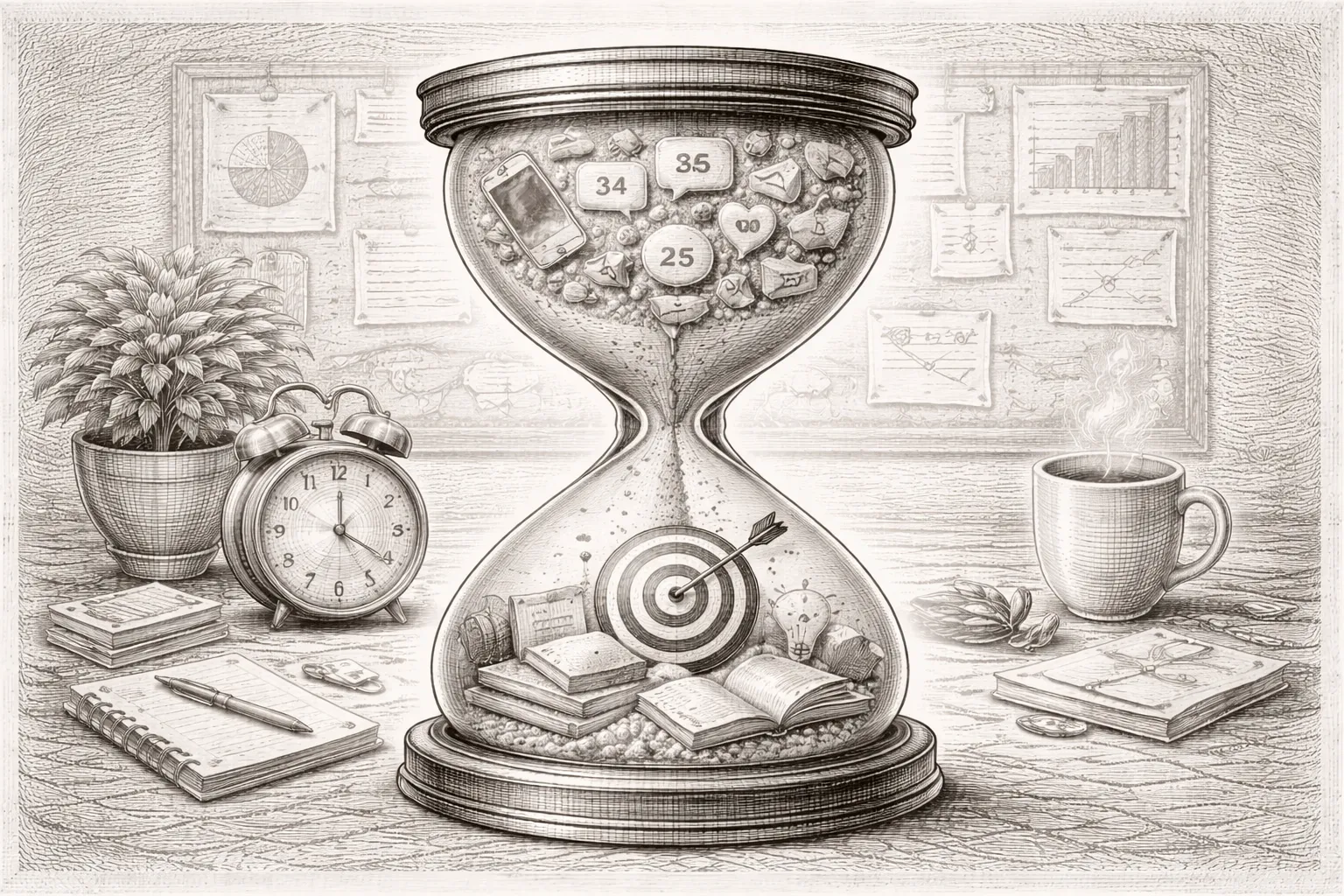
You block three hours for deep work, silence all notifications, and sit down determined to finally make progress on that complex project. Fifteen minutes in, your mind starts wandering. At 25 minutes, you’re fighting the urge to check email. By 40 minutes, you’ve already broken focus twice and feel exhausted. The time is protected, but you can’t actually use it.
Focus isn’t just about eliminating distractions—it’s a cognitive capacity that atrophies from underuse and must be rebuilt systematically like physical endurance.
The Problem
You can maintain intense focus for maybe 20-30 minutes before your attention starts fragmenting. You know complex work requires longer stretches—2, 3, even 4 hours of sustained concentration—but you can’t access those states anymore. Somewhere along the way, your baseline attention span shortened without you noticing.
The decline happened gradually. Years of tab-switching, notification-responding, and quick-context-hopping trained your brain for short bursts of attention. Now when you try to focus for extended periods, it feels physically uncomfortable. Your mind generates urgent reasons to switch tasks: “I should check if that email arrived.” “This other task is probably more important.” “I need a break already.” These aren’t real needs—they’re your brain resisting sustained attention because it’s no longer adapted to it.
What’s particularly frustrating is that you can’t force your way through this. Willpower gets you 10-15 extra minutes, but then it collapses entirely. You end the day feeling like you “tried to focus” without actually producing deep work. The protected time didn’t translate to cognitive capacity because your attention system can’t sustain what you’re asking of it.
Why this happens to knowledge workers
Your attentional control relies on neural networks in the prefrontal cortex that strengthen with use and weaken with disuse, similar to muscles. Research suggests that sustained attention is metabolically expensive—your brain consumes significant glucose and oxygen to maintain focus. When you’ve trained your brain through years of fragmented attention, the neural pathways supporting sustained focus literally atrophy.
The mechanism involves two competing systems: task-positive networks (activated during focused work) and task-negative networks (activated during mind-wandering and rest). Switching between tasks frequently strengthens your task-switching ability while weakening your capacity to keep task-positive networks activated continuously. You’ve become efficient at changing focus, which makes you inefficient at maintaining it.
Many people find that their focus degradation has accelerated dramatically in recent years. Research suggests smartphone usage patterns—brief, frequent interactions throughout the day—create the strongest training effect toward fragmented attention. You’re not weak-willed; you’ve literally trained your brain to expect attention switches every few minutes, and now it struggles when you ask it to do something different.
What Most People Try
The most common approach is scheduling longer focus blocks and hoping your brain adapts automatically. You block three hours on your calendar, eliminate distractions, and expect yourself to use the time productively. But on day one, you can only sustain genuine focus for 30 minutes. The remaining time is wasted fighting distraction, checking the clock, and feeling frustrated about your inability to concentrate.
Some people try brute-force training: refusing to break focus no matter how uncomfortable it becomes. You sit at your desk determined not to switch tasks even as your attention quality deteriorates. This sometimes works short-term through sheer willpower but leads to burnout because you’re treating focus like a character test rather than a trainable capacity.
Others attempt to make focusing easier rather than building capacity: breaking work into 25-minute Pomodoro intervals with frequent breaks, switching tasks when attention wanes, or accepting that they can only do deep work in short bursts. These strategies help you function with limited attention span but don’t expand the capacity itself. You’ve adapted to your limitation rather than addressing it.
Some knowledge workers try pharmaceutical shortcuts: excessive caffeine, nootropics, or ADHD medications (prescribed or not). These can temporarily extend attention but often create dependency and side effects without building genuine stamina. When the chemical enhancement wears off, your baseline capacity remains unchanged or even worse.
None of these approaches treat focus as a trainable capacity that improves systematically with progressive overload, similar to physical fitness. You’re either expecting immediate transformation, forcing unsustainable effort, accommodating your current limits, or seeking chemical shortcuts—but not actually building the underlying neural capacity for sustained attention.
What Actually Helps
1. Start with your actual baseline and add 10-15% weekly
The most effective strategy is measuring your current genuine focus capacity and increasing it gradually through consistent practice at the edge of your ability. This means timing how long you can sustain quality attention before it naturally breaks (not how long you can force yourself to stay seated), then training at slightly beyond that duration.
Research suggests that training at 10-15% beyond your current capacity creates adaptation without triggering overwhelming resistance. If you can genuinely focus for 25 minutes, your training sessions should be 28-30 minutes. After one week of consistent practice at that duration, increase to 32-35 minutes. The progression feels almost imperceptibly difficult, which is exactly right—dramatic overreach leads to failure and regression.
The key is distinguishing between “seated at desk” and “genuinely focused.” You’re measuring quality attention: time when you’re actively engaging with complex material, building mental models, making progress. Staring at your screen while mind-wandering doesn’t count. Time spent fighting the urge to check email doesn’t count. Only genuine engagement counts.
How to start: For three days, time your genuine focus capacity without trying to extend it—just note when your attention naturally breaks despite your best effort. Take the average. That’s your baseline. For the next week, do one focus session daily at baseline + 3-5 minutes. Don’t check email, switch tasks, or break focus until the timer completes. After one successful week, add another 3-5 minutes.
Many people resist this because starting from 25-30 minutes feels embarrassingly low compared to the 3-hour sessions they believe they should be able to do. But you’re not training toward some abstract ideal—you’re training from your actual current capacity, which is the only approach that works.
2. Create focus sessions with clear scope and exit criteria
Extended focus becomes sustainable when your brain knows what “done” looks like for the session. Research suggests that open-ended work sessions (“I’ll work on this project as long as I can focus”) trigger more mental resistance than sessions with specific completion criteria (“I’ll complete these three subsections”).
The mechanism involves cognitive closure. Your brain maintains better sustained attention when working toward a defined endpoint than when working indefinitely. Vague sessions create anxiety about duration and accomplishment, which burns attentional resources. Scoped sessions let your brain allocate its focus budget more efficiently.
This means designing focus sessions around specific deliverables rather than time blocks: “Draft the argument structure for section 2” rather than “Work on the paper for 90 minutes.” Time becomes a constraint (don’t exceed 90 minutes) rather than the goal (fill 90 minutes). Your attention stays oriented toward the work itself instead of monitoring the clock.
How to start: Before each focus session, write one sentence describing what completed looks like for this session. Make it specific enough that you’ll know unambiguously when you’ve finished. Set a time limit 10-15% beyond your current capacity. Work until you complete the scope or hit the time limit, whichever comes first. Track over two weeks whether having clear exit criteria reduces the mental resistance during sessions.
This feels like adding overhead, but research suggests the 30 seconds spent defining scope pays for itself many times over in reduced mid-session anxiety and improved attention quality. You’re trading brief planning time for sustained execution capacity.
3. Protect the immediate post-session window for recovery
Building focus stamina isn’t just about the work sessions—it’s about recovery between them. Research suggests that the 15-20 minutes immediately after sustained focus critically determine how quickly you can engage in another session later. Poor recovery (immediately switching to shallow tasks, checking notifications) depletes your capacity for subsequent sessions.
The recovery mechanism involves two factors: metabolic restoration (replenishing glucose and clearing metabolic byproducts from the prefrontal cortex) and attentional reset (disengaging task-positive networks so they can reactivate fresh later). Neither happens effectively if you immediately shift to different cognitively demanding tasks.
Effective recovery means genuine cognitive rest: walking without podcasts, sitting quietly, doing simple physical tasks, or engaging in completely automatic activities that require no executive function. Not email, not social media, not planning your next task—actual rest. This feels unproductive and many people skip it, which severely limits their daily focus capacity.
How to start: After completing each focus session, set a 15-minute timer and do something that requires zero cognitive effort: walk around your space, stretch, stare out the window, or make tea slowly and deliberately. Do not check phone, email, messages, or start planning. Only after the 15-minute recovery can you engage with other tasks. Track whether this protected recovery time improves your ability to do a second focus session later in the day.
The resistance here is that 15 minutes feels like too long to “waste” doing nothing when you have so much to do. But if those 15 minutes enable a second high-quality focus session that would otherwise be impossible, you’ve gained net productivity, not lost it.
The Takeaway
Focus stamina is a trainable capacity that improves through progressive overload—starting from your actual baseline and increasing duration by 10-15% weekly. Combined with clear session scope and protected recovery windows, this systematic approach rebuilds the neural capacity for sustained attention that fragmented modern work patterns have eroded. You’re not suddenly becoming capable of 4-hour focus sessions through willpower—you’re training the underlying cognitive systems to support progressively longer periods of genuine engagement, the same way you’d build any other form of endurance.