Best Investment Books for Beginners in 2025
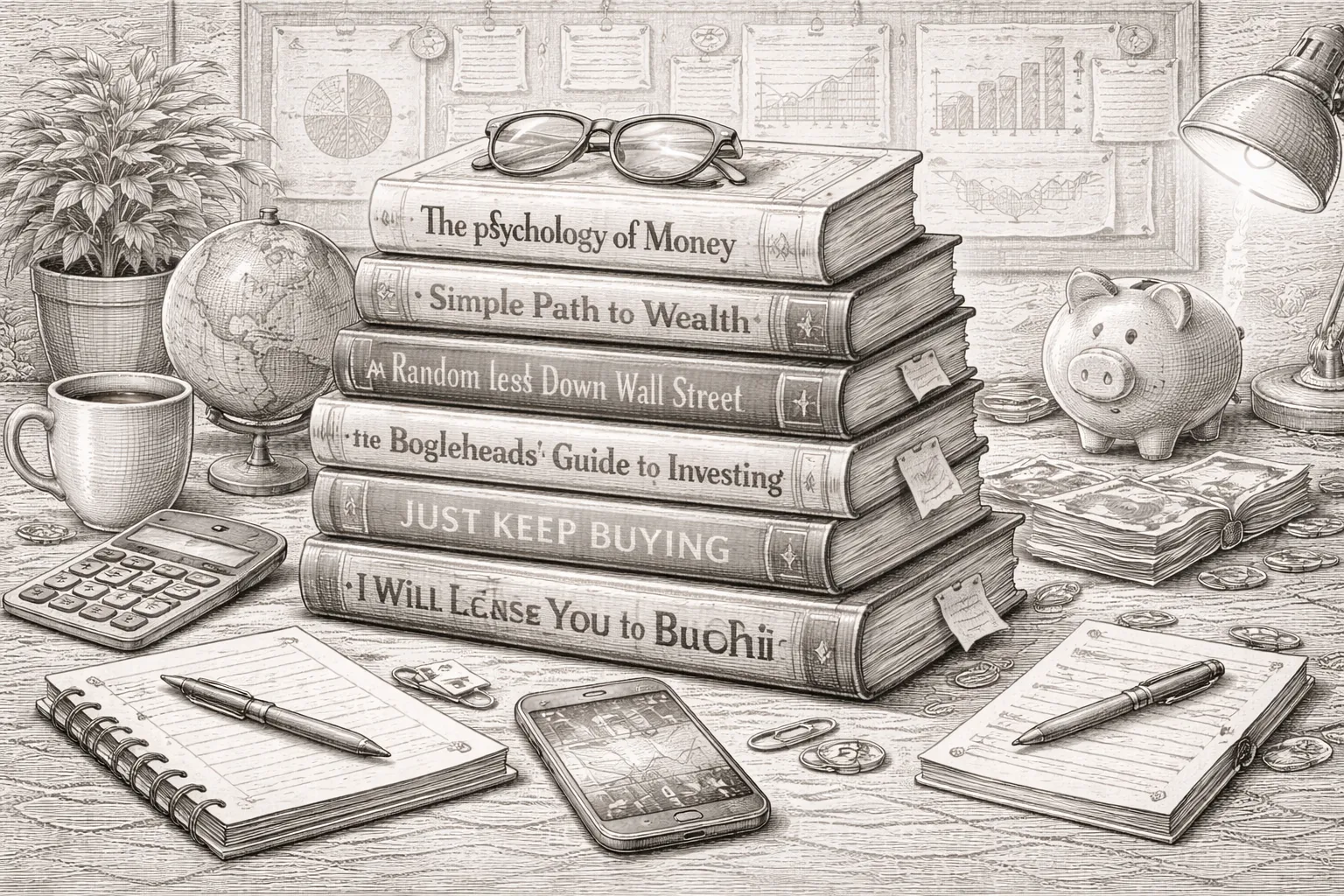
Most people who try to learn investing from books quit within three chapters. Not because investing is impossibly hard, but because most investment books are either impenetrably academic or dangerously oversimplified. After reading them, you still don’t know what to actually do with your money.
The books that work teach you the mental models first, then the mechanics. They assume you’re smart but inexperienced, and they don’t patronize you with “get rich quick” nonsense.
Why Most Investment Books Fail Beginners
Investment books fall into two traps. Academic texts assume you already understand terms like “beta,” “alpha,” and “discount rates.” They’re written for finance students, not people who just want to invest their savings intelligently. You’re three pages in and already lost.
The other extreme: books that promise wealth through real estate flipping, day trading, or “secret” stock picks. These treat investing like gambling with a system. They sell aspiration, not education. You finish the book excited but with no transferable knowledge—just a specific bet the author wants you to make.
Good beginner investment books sit in the middle. They explain why markets work the way they do, using plain language and real examples. They teach principles you can apply to any investment decision for the rest of your life, not just the current market cycle. They’re honest about risk, uncertainty, and the limits of what anyone can predict.
Most importantly, they change how you think about money. After reading them, you stop seeing investing as something mysterious experts do and start seeing it as a learnable skill with knowable principles.
What you actually need from an investment book as a beginner
You need a book that answers the fundamental question: “Where should I put my money and why?” Everything else is detail.
The best beginner investment books teach decision frameworks, not stock picks. They explain the difference between speculation and investing, between price and value, between risk and volatility. They give you a mental toolkit for evaluating any investment opportunity, whether it’s stocks, bonds, real estate, or your friend’s startup.
You also need honesty about what’s possible. Books that promise 20% annual returns are lying or survivorship-biased. Books that claim investing is “simple” are technically correct but misleadingly so—simple doesn’t mean easy or effortless.
The ideal beginner book acknowledges that investing requires patience, discipline, and accepting uncertainty. It teaches you to think in probabilities, not certainties. It explains why low-cost index funds beat most active investors, but also why some people choose active investing anyway. It gives you enough knowledge to make informed decisions about your own money, matched to your own risk tolerance and time horizon.
How This List Works
Selection criteria:
- I’ve read each book cover-to-cover, some multiple times
- The strategies taught actually work for beginners with modest savings
- No prerequisite finance knowledge required
- Books are available in English and reasonably priced (under $30)
- Mix of timeless classics and modern updates
What “beginner” means: You have some money to invest (even $1,000 counts), a basic understanding that stocks exist, and zero formal finance education. You might have a 401(k) but don’t really know what’s in it. You’re not looking to day trade or get rich quick—you want to build wealth slowly and sleep well at night.
About affiliate links: This article contains Amazon affiliate links (tag: focusdividend-22). If you purchase through these links, I may earn a small commission at no extra cost to you. I only recommend books I’ve personally read and found valuable for learning investing.
Quick Comparison
| Book | Best For | Difficulty | Length | Key Takeaway |
|---|---|---|---|---|
| The Intelligent Investor | Understanding value investing philosophy | Beginner+ | 640 pages | Price is what you pay, value is what you get |
| A Random Walk Down Wall Street | Understanding why index funds work | Beginner | 448 pages | You can’t beat the market consistently |
| The Little Book of Common Sense Investing | Starting with index funds now | Beginner | 216 pages | Buy the whole market, hold forever |
| The Psychology of Money | Fixing your money mindset | Beginner | 256 pages | Behavior matters more than intelligence |
| Your Money or Your Life | Connecting investing to life goals | Beginner | 368 pages | Money is life energy—invest it wisely |
Start with The Little Book of Common Sense Investing if you want to start investing immediately—it’s short, practical, and tells you exactly what to do. Then read A Random Walk Down Wall Street to understand why that strategy works. Save The Intelligent Investor for when you’re ready to go deeper into individual stock analysis.
The Rankings: Books That Actually Teach Beginners
1. The Intelligent Investor by Benjamin Graham

Published: 1949 (revised 2006) | Pages: 640 | Difficulty: Beginner+
What it teaches: The fundamental distinction between investing and speculation, how to analyze stocks based on intrinsic value rather than market price, and why emotional discipline matters more than intelligence in investing.
Why it works for beginners: Graham writes for the “defensive investor”—someone who wants good results without spending their life researching stocks. He assumes you’re smart but busy, and teaches principles that apply to any market condition. The updated edition includes commentary by Jason Zweig that translates 1940s examples into modern context.
Key concepts you’ll learn:
-
Margin of Safety: The principle of buying assets for significantly less than they’re worth, creating a buffer against errors in judgment or bad luck. Graham argues you should only invest when the gap between price and value is wide enough to protect you even if you’re partially wrong. This single concept prevents most beginner mistakes—overpaying for “hot” stocks, buying at market peaks, or investing in things you don’t understand just because everyone else is.
-
Mr. Market: Graham’s metaphor for market behavior—imagine a business partner who offers to buy your share or sell you his every day, at wildly fluctuating prices based on his mood. You don’t have to accept his offers. This reframes market volatility from something scary into something you can exploit. When Mr. Market is depressed and offering low prices, you buy. When he’s euphoric and offering high prices, you sell or hold.
-
Defensive vs. Enterprising Investor: Graham divides investors into two types. Defensive investors want good results with minimum effort—he recommends index funds and high-grade bonds. Enterprising investors are willing to dedicate serious time to research and analysis—they can potentially beat the market but must truly commit. Most beginners should be defensive investors. This framework stops you from half-assing active investing, which is worse than not trying.
The most valuable chapter: Chapter 8, “The Investor and Market Fluctuations,” explains why you should welcome market crashes rather than fear them. Graham shows how volatility creates opportunity for disciplined investors while destroying impulsive ones. He introduces Mr. Market here, and the chapter alone is worth the book’s price—it’s the antidote to panic selling during downturns.
Practical application:
After reading this, you’ll evaluate every investment by asking: “What is this actually worth, independent of its current price?” For stocks, that means looking at earnings, assets, and competitive position, not just price momentum. For your portfolio overall, it means setting a target allocation (Graham suggests 50/50 stocks/bonds for defensive investors) and rebalancing when markets swing.
The most immediately useful advice: don’t try to time the market. Instead, use dollar-cost averaging—invest a fixed amount monthly regardless of market conditions. When prices are high, you buy less. When prices are low, you buy more. Over decades, this eliminates timing risk and exploits volatility.
What beginners struggle with in this book:
Graham’s examples are from the 1940s-1970s, discussing companies that no longer exist or industries that have transformed completely. You’ll read about railroads and utilities as growth sectors, which feels dated. Zweig’s commentary helps, but you still need to translate principles across eras.
Also, Graham’s recommended stock analysis techniques (looking at price-to-book ratios, current ratios, etc.) assume you’re willing to read financial statements. Many beginners aren’t. That’s fine—Graham himself says defensive investors should stick to index funds. But if you skip the analysis chapters, you’re missing half the book.
Best read when:
You’ve been investing for 6-12 months and are ready to move beyond “just buy index funds” into understanding why that works and when it might not. Or you’re tempted to buy individual stocks and need the discipline to do it right. Don’t read this as your first investment book—you’ll get overwhelmed. Read it as your second or third.
Real limitation:
Graham’s world assumed stocks were often undervalued and patient analysis could find bargains. Today’s market is more efficient—information spreads instantly, millions of professional analysts scrutinize every company. True “Graham-style” bargains are rare. His principles still work, but opportunities are harder to find. For most people, his advice leads to: “Just buy index funds.” Which is correct, but you could learn that from a 200-page book instead of 640 pages.
Follow-up reading: After this, read Security Analysis (also by Graham) if you want to seriously analyze individual stocks, or Common Stocks and Uncommon Profits by Philip Fisher for a different perspective on growth investing.
2. A Random Walk Down Wall Street by Burton Malkiel

Published: 1973 (12th edition 2019) | Pages: 448 | Difficulty: Beginner
What it teaches: Why stock prices are unpredictable in the short term (the “random walk” theory), why most professional investors fail to beat market averages, and why low-cost index funds are the optimal choice for most people.
Why it works for beginners: Malkiel combines academic rigor with accessible writing. He explains efficient market theory without jargon, uses historical data to prove his points, and gives specific portfolio recommendations. Unlike theoretical books, this one tells you exactly what to buy and why.
Key concepts you’ll learn:
-
Efficient Market Hypothesis: Markets incorporate all available information into prices almost instantly. If everyone knows a company is going to do well, the stock price already reflects that knowledge. You can’t consistently profit from public information because millions of other investors are trying to do the same thing. This doesn’t mean markets are always correct—it means they’re unpredictable. Occasional mispricings happen, but you can’t reliably identify them in advance.
-
Why Active Management Fails: Malkiel shows data proving that over 80% of actively managed mutual funds underperform their benchmark indexes over 15+ year periods. The reasons: trading costs, management fees (often 1-2% annually), taxes from frequent trading, and the impossibility of consistently predicting short-term price movements. The few managers who beat the market are often just lucky—statistically, some people will get coin flips right ten times in a row.
-
Index Fund Strategy: Instead of trying to pick winning stocks or managers, buy the entire market through low-cost index funds. You get instant diversification, minimal fees (often 0.03-0.1% annually), tax efficiency, and performance that beats most professionals. Malkiel specifically recommends total stock market index funds and advocates a portfolio based on your age (subtract your age from 110-120 to get your stock allocation, with the rest in bonds).
The most valuable chapter:
Chapter 14, “A Practical Guide for Random Walkers,” gives specific portfolio recommendations by age and risk tolerance. It’s the actionable payoff after 13 chapters of theory. Malkiel tells you which funds to buy, how to allocate between stocks and bonds, how to rebalance, and when to adjust as you age. You could skip straight to this chapter and have a solid investment plan, though you’d miss the reasoning that makes you stick with it during market crashes.
Practical application:
Open a brokerage account (Vanguard, Fidelity, Schwab). Buy a total stock market index fund (like VTI or VTSAX) and a total bond market index fund (like BND or VBTLX). Allocate based on your age—if you’re 30, put 80-90% in stocks, 10-20% in bonds. Invest every paycheck. Rebalance once a year. Ignore everything else.
That’s it. Malkiel spends 400 pages explaining why this boring strategy beats trying to be clever. The hardest part is emotional—doing nothing during crashes while everyone around you panics or chases hot stocks.
What beginners struggle with in this book:
Malkiel’s explanations of efficient market theory and random walks can feel abstract and academic in early chapters. You’re reading about statistical tests and correlation coefficients, wondering when he’ll tell you what to actually do. The payoff comes later, but beginners sometimes quit before getting there.
Also, Malkiel is dismissive of technical analysis, day trading, and most active investing strategies. If you want to believe you can beat the market, this book is frustrating—he methodically dismantles every approach with data. Intellectually, you know he’s right. Emotionally, accepting you can’t beat the market feels like giving up.
Best read when:
You’re choosing where to invest your 401(k) or IRA and want to understand your options. Or you’re tempted by active trading and need someone to talk you out of it. Or you’ve read investing forums and your head is spinning with conflicting advice. Malkiel cuts through noise and gives you a clear, evidence-based strategy.
Real limitation:
Markets have changed since 1973. The rise of algorithmic trading, ETFs, and global capital flows means today’s markets may be even more efficient than when Malkiel wrote. But paradoxically, some argue markets are less efficient—more driven by momentum and sentiment than fundamentals. Malkiel’s updates address this, but the core question remains: if everyone indexes, who does the price discovery?
For beginners, this is academic. Even if markets aren’t perfectly efficient, they’re efficient enough that beating them consistently is extremely hard. Index funds still win for 80%+ of investors.
Follow-up reading: After this, read The Little Book of Common Sense Investing for a more concise version of the same argument, or The Four Pillars of Investing by William Bernstein for deeper portfolio construction guidance.
3. The Little Book of Common Sense Investing by John C. Bogle

Published: 2007 (10th anniversary edition 2017) | Pages: 216 | Difficulty: Beginner
What it teaches: One core idea: buy the entire stock market through index funds, hold forever, and ignore everything else. Bogle, founder of Vanguard, built his entire career on this principle and proves why it works.
Why it works for beginners: It’s short, focused, and actionable. No complex analysis, no dense theory—just ruthlessly practical advice. Bogle writes like he’s talking to his grandchildren: clear, patient, and honest. You can read this in an afternoon and have a complete investment strategy.
Key concepts you’ll learn:
-
The Cost Matters Hypothesis: Investment returns are unpredictable, but costs are certain. Every dollar you pay in fees, trading commissions, or taxes is a dollar you don’t keep. Over 40 years, a 2% annual fee compounds to eat half your returns. Bogle shows that the single best predictor of fund performance isn’t the manager’s skill or strategy—it’s the fee. Low-cost index funds charging 0.03% beat high-cost active funds charging 1-2% not through superior stock picking, but through avoiding costs.
-
Reversion to the Mean: Funds that beat the market last year usually underperform the next year. Hot sectors cool off. Yesterday’s winning stocks become tomorrow’s losers. Over long periods, everything reverts to the market average. Chasing last year’s winners is a guaranteed losing strategy. Instead, own everything through an index fund. You’ll get the market return, which beats most investors because you’re not destroying value through costs and bad timing.
-
Stay the Course: The biggest risk isn’t market crashes—it’s your own behavior. Selling during downturns locks in losses. Buying during euphoria locks in overvaluation. Bogle’s career-defining advice: buy index funds, reinvest dividends, never sell except when you need the money (retirement, emergency). Ignore daily fluctuations, annual returns, economic predictions. Just hold. This patience is harder than it sounds, but it’s the difference between winning and losing in investing.
The most valuable chapter:
Chapter 4, “How Most Investors Turn a Winner’s Game Into a Loser’s Game,” explains how investors sabotage themselves. Bogle shows that while the stock market returned 10% annually over decades, the average investor earned only 4-5% because they bought high (during booms), sold low (during crashes), and chased performance. The gap between market returns and investor returns is entirely self-inflicted. This chapter is a gut punch if you’ve ever panic-sold or chased hot stocks.
Practical application:
If you’re in the U.S., open a Vanguard account. Buy VTSAX (total stock market index fund) or VTI (the ETF version). If you’re young, put 90-100% of your portfolio there. If you’re near retirement, split it with bonds (Bogle suggests bond allocation equal to your age). Set up automatic monthly investments. Check your account once a year. That’s it.
Outside the U.S., buy the local equivalent—a total market index fund with fees under 0.2%. The principle is universal even if the specific fund changes.
What beginners struggle with in this book:
Bogle repeats himself. A lot. He makes the same point about costs five different ways across multiple chapters. For some readers, this reinforces the message. For others, it feels padded. The book could be 100 pages and convey the same information.
Also, Bogle’s tone is paternalistic. He writes like a grandfather giving advice: gentle, but firm, and occasionally preachy. Some people find this comforting. Others find it condescending.
Best read when:
You’re ready to start investing right now and don’t want to spend weeks researching. This is the “just tell me what to do” book. Read it when you’ve opened a brokerage account and need to decide where to put your first $1,000. Or read it when you’re doubting your index fund strategy and need reassurance that boring is good.
Real limitation:
Bogle’s strategy is optimal for most people most of the time. But “most” isn’t “all.” If you’re financially sophisticated, have time to research, and genuinely enjoy stock analysis, active investing can be rewarding (financially and intellectually). Bogle dismisses this entirely. He’s probably right that you’ll underperform, but he doesn’t acknowledge that some people invest for reasons beyond maximum returns—learning, engagement, control.
Also, the book is U.S.-centric. International readers need to translate his specific fund recommendations to their markets.
Follow-up reading: After this, you don’t need more books—go invest. But if you want deeper theory, read A Random Walk Down Wall Street. If you want historical context on Bogle’s impact, read The Bogleheads’ Guide to Investing.
4. The Psychology of Money by Morgan Housel

Published: 2020 | Pages: 256 | Difficulty: Beginner
What it teaches: How people think about money, why smart people make terrible financial decisions, and why behavior matters more than technical knowledge in building wealth.
Why it works for beginners: Housel tells stories instead of lecturing. Each chapter is a short essay exploring one idea through historical examples and personal anecdotes. It reads like a collection of thought experiments, not a textbook. You’ll finish feeling like you understand yourself better, not just investments.
Key concepts you’ll learn:
-
Wealth is What You Don’t See: People equate wealth with consumption—big houses, fancy cars, luxury vacations. But real wealth is invisible: money in the bank, investments quietly compounding, the ability to buy freedom and options. Spending money to look wealthy prevents you from becoming actually wealthy. Housel argues the highest form of wealth is waking up and doing what you want without financial pressure. That requires saving and investing, not spending.
-
The Role of Luck and Risk: Every financial outcome is part skill, part luck, part risk. People who got rich in a bull market like to attribute it to brilliance. People who lost money in a crash blame bad luck. The truth: both matter. You can make good decisions and lose money. You can make bad decisions and get rich (for a while). This doesn’t mean skill doesn’t matter—it means you should be humble, avoid overconfidence, and build safety margins into your plans.
-
Room for Error: The most important investing principle isn’t maximizing returns—it’s surviving long enough to benefit from compounding. Housel advocates for portfolio strategies that let you sleep at night, even if they’re not mathematically optimal. Holding 10% cash seems wasteful (it earns nothing), but it prevents panic selling during crashes. Taking slightly less risk might mean lower returns, but it means you stick with the plan for 30 years instead of quitting after 5.
The most valuable chapter:
Chapter 10, “Wealth is What You Don’t See,” redefines what it means to be rich. Housel contrasts two paths: high income spent on visible consumption (nice car, big house) versus moderate income with high savings rate. The first looks rich but is fragile—income disruption causes crisis. The second looks normal but is resilient—has options, flexibility, and actual wealth. This chapter changes how you think about lifestyle inflation and “keeping up with the Joneses.”
Practical application:
After reading this, you’ll make different decisions about savings rate, risk tolerance, and spending. Instead of asking “What’s the optimal investment strategy?” you’ll ask “What strategy can I stick with for 30 years?” Instead of maximizing returns, you’ll optimize for sleep quality and stress reduction.
Concretely: set a savings rate you can sustain (Housel suggests 10-20% minimum). Build a cash emergency fund large enough that market volatility doesn’t scare you (6-12 months expenses). Invest the rest in diversified index funds. Accept that this won’t maximize returns—it maximizes probability of success.
What beginners struggle with in this book:
It’s not a how-to guide. Housel doesn’t tell you which stocks to buy or how to build a portfolio. If you want actionable steps, you’ll finish feeling inspired but unsure what to do next. This is a mindset book, not a tactics book.
Also, some chapters feel disconnected. The book is a collection of essays, not a linear argument. You can read chapters out of order without losing much. This makes it easy to digest but less cohesive than other investment books.
Best read when:
You’re making good money but can’t seem to save it—you need perspective on spending and wealth. Or you’ve started investing but feel anxious about market movements—you need emotional frameworks, not more technical knowledge. Or you’ve been investing for years and want to reflect on whether your strategy matches your actual goals and values.
Real limitation:
Housel writes primarily about the U.S. investing experience and American attitudes toward wealth. Some examples don’t translate to other cultures or economic systems. The psychological principles are universal, but the context is Western and individualistic.
Also, the book sometimes oversimplifies. Housel favors compelling stories over nuanced analysis. That makes for engaging reading but occasionally sacrifices depth. You’ll get the main idea, but miss edge cases and complications.
Follow-up reading: After this, read Your Money or Your Life for practical steps on aligning spending with values, or Thinking, Fast and Slow by Daniel Kahneman for deeper behavioral economics.
5. Your Money or Your Life by Vicki Robin and Joe Dominguez

Published: 1992 (updated 2018) | Pages: 368 | Difficulty: Beginner
What it teaches: How to calculate your real hourly wage (accounting for work-related expenses and time), track every dollar you spend, and align your money choices with your actual values and life goals.
Why it works for beginners: It tackles the question most investment books ignore: Why are you investing? What’s the money for? Robin and Dominguez argue that investing without purpose is pointless—you need to define “enough,” then invest to reach it. The book is half philosophy, half workbook, with specific exercises to transform your relationship with money.
Key concepts you’ll learn:
-
Life Energy: Money represents your time and energy. When you spend $100, you’re not spending paper—you’re spending the hours you worked to earn that $100. Calculate your real hourly wage (salary divided by total work-related time, minus work-related expenses like commuting, professional clothes, stress-relief spending). Maybe your $30/hour job is really $15/hour after accounting for everything. This reframes every purchase: “Is this worth 6 hours of my life?”
-
The Fulfillment Curve: More stuff doesn’t equal more happiness beyond a certain point. The curve rises as you meet basic needs (shelter, food, security), peaks at “enough” (comfort, some luxury, financial security), then declines as you accumulate excess (stress from maintenance, clutter, debt). Most people overshoot “enough” and make themselves miserable. The goal: identify your peak and stop there. Invest the surplus instead of spending it.
-
Financial Independence: The ultimate goal is crossover—when passive income from investments exceeds your monthly expenses. At that point, work becomes optional. You might keep working, but it’s a choice, not a requirement. The path: (1) reduce expenses to essentials plus meaningful luxuries, (2) maximize savings rate, (3) invest in safe, dividend-producing assets until crossover. The authors achieved this in their 30s on moderate incomes by living intentionally.
The most valuable chapter:
Step 2, “Being in the Present—Tracking Your Life Energy,” teaches you to track every dollar for a month and categorize it. Not budgeting (imposing future limits) but accounting (seeing past reality). You’ll discover you spent $300 on restaurants you barely remember, $150 on subscriptions you don’t use, $400 on impulse purchases. The awareness itself changes behavior—most people cut spending 20-30% without feeling deprived just by seeing where money actually goes.
Practical application:
For one month, track every purchase. Write it down—amount, category, date. At month end, total each category. Ask: “Did I receive fulfillment proportional to life energy spent?” Highlight categories in three colors: green (great value, got happiness/utility), yellow (neutral), red (regret or waste).
Next month: keep green spending, reduce yellow, eliminate red. Track the savings. Invest them in index funds or dividend stocks. Each month, calculate your investment income and compare to monthly expenses. Watch the gap close. When investment income exceeds expenses, you’ve reached financial independence.
What beginners struggle with in this book:
The exercises are time-consuming. Tracking every purchase, calculating real hourly wage, creating spending charts—it’s work. Many readers skim the book without doing the exercises, then wonder why nothing changes. The transformation requires participation, not just reading.
Also, the book’s tone can feel judgmental. Robin and Dominguez advocate extreme frugality and early retirement. If you like your job or enjoy spending money on experiences, some chapters feel preachy. The principles work even if you don’t adopt their full philosophy, but they don’t always acknowledge that.
Best read when:
You’re earning good money but living paycheck-to-paycheck and don’t know where it all goes. Or you’re considering a career change and want to understand your real financial needs. Or you feel trapped by work and wonder if there’s a path to more freedom. This book reframes retirement not as age 65, but as “having enough.”
Real limitation:
The book’s investment advice is outdated. Robin and Dominguez recommend Treasury bonds and bank CDs, which made sense in the 1990s (when interest rates were 6-8%) but return almost nothing today. The updated edition mentions index funds, but the core financial independence calculation assumes bond-level returns. You’ll need to supplement with modern investment guidance (like Bogle’s book).
Also, the path to financial independence requires a high savings rate (often 50%+ of income). That’s impossible for people with low incomes, debt, or dependents. The book acknowledges this but doesn’t offer much help beyond “increase income and reduce spending”—easier said than done.
Follow-up reading: After this, read The Simple Path to Wealth by JL Collins for updated investment strategy aligned with financial independence goals, or Early Retirement Extreme by Jacob Lund Fisker for a more intense frugality approach.
Honorable Mentions Worth Your Time
The Four Pillars of Investing by William Bernstein

Why it didn’t make top 5: More technical than most beginners need. Bernstein dives deep into portfolio theory, asset allocation models, and historical return data. It’s excellent if you want to understand the math behind investing, but it’s dense. The four pillars (theory, history, psychology, business) each get detailed treatment, which means 300+ pages before you get to actionable advice.
Why it’s still valuable: It’s the best book for understanding why diversification works and how to construct portfolios for different goals. If you’re the type who needs to understand the engine before driving the car, this is your book. Bernstein also has a gift for historical storytelling—his chapters on market bubbles and crashes are both educational and entertaining.
Best for: Readers who finished Bogle and Malkiel and want deeper theory. Or people building complex portfolios (international stocks, REITs, small-cap value) and need guidance on allocation percentages.
The Bogleheads’ Guide to Investing by Taylor Larimore, Mel Lindauer, and Michael LeBoeuf

Why it didn’t make top 5: It’s essentially a community-written expansion of Bogle’s work. If you’ve read Bogle, this adds detail but not new philosophy. The Bogleheads are devotees of index investing, so the book preaches to the converted.
Why it’s still valuable: Extremely practical and comprehensive. Covers tax-advantaged accounts (401k, IRA, HSA), tax-loss harvesting, estate planning, and international investing. It’s like having a financial advisor who charges nothing and just wants you to succeed. The FAQ format makes it easy to look up specific questions.
Best for: People who’ve decided to index invest and want implementation details. How to set up accounts, which funds to buy in which accounts for tax efficiency, how to rebalance—this book handles the logistics.
Common Stocks and Uncommon Profits by Philip Fisher

Why it didn’t make top 5: It’s for people who want to pick individual growth stocks, which most beginners shouldn’t do. Fisher’s “scuttlebutt” method (talking to customers, suppliers, competitors) is time-intensive and requires business insight most beginners lack.
Why it’s still valuable: If Graham teaches you to find undervalued companies, Fisher teaches you to find great companies. His focus on management quality, competitive advantages, and long-term growth potential influenced investors like Warren Buffett. The “fifteen points to look for” checklist is a masterclass in qualitative analysis.
Best for: Beginners who’ve already mastered index investing but want to dedicate 10-20% of their portfolio to individual stocks. Or people in specific industries who can leverage insider knowledge.
Books to Skip (And Why)
Rich Dad Poor Dad by Robert Kiyosaki
Why it’s overhyped: The book’s core message—“buy assets, not liabilities”—is fine, but buried under motivational fluff and questionable advice. Kiyosaki pushes real estate speculation and starting businesses without acknowledging risk. The “rich dad” story is likely fictional. Worst: it makes investing sound easy, which sets up beginners for disappointment.
Better alternative: Read The Psychology of Money instead. It covers similar mindset shifts (assets vs. consumption, building wealth vs. looking wealthy) with honesty about difficulty and risk.
The Millionaire Next Door by Thomas Stanley
Why it fails beginners: It’s a demographics study about wealthy Americans, not an investing guide. You’ll learn that millionaires drive old cars and live below their means, which is interesting but not actionable. The book describes wealthy people without teaching you how to become one.
Better alternative: Read Your Money or Your Life for actual steps to build wealth through frugality and investing, not just stories about people who already did it.
How to Read These Books Effectively
Reading order for complete beginners
-
Start with: The Little Book of Common Sense Investing - Takes 3-4 hours, gives you a complete investment strategy. You’ll learn to buy index funds and hold them. That alone puts you ahead of most investors.
-
Then read: The Psychology of Money - Addresses the behavioral challenges. After Bogle tells you what to do, Housel explains why you’ll be tempted not to do it (and how to resist).
-
Finally: A Random Walk Down Wall Street - Provides the academic foundation. Now you understand not just what to do and why you’ll struggle, but also why the strategy works and why alternatives fail.
Save The Intelligent Investor and Your Money or Your Life for later—they’re important but not urgent. You can invest successfully without reading them, though you’ll benefit eventually.
Reading strategies that actually work
Don’t read cover-to-cover immediately: Skim first. Read the introduction and conclusion of each chapter. Identify which chapters address your immediate questions. Go deep on those. Backfill the rest later. Beginners often bog down in early chapters (market history, theory) and never reach practical advice. Skip to the practical sections first, then return to theory once you’re invested and want deeper understanding.
Take implementation breaks: After finishing The Little Book of Common Sense Investing, stop reading. Open a brokerage account. Buy an index fund. Let it sit for a month while you watch (and ignore) daily fluctuations. Experience the anxiety of seeing your balance drop 3% in a day. Feel the temptation to sell or buy more. Live with the uncertainty. Then read the next book. Concepts only stick when you’ve felt the emotions they address.
Keep a concept journal: Write down one insight per chapter in your own words. Not highlights from the book—your interpretation, in your language. Ask: “How does this apply to my money?” If you can’t explain it simply, you don’t understand it yet. This also helps you synthesize across books. You’ll notice when different authors say the same thing (usually a sign it’s important) or contradict each other (usually a sign both have partial truth).
Common reading mistakes
Reading too many books without implementing anything: You finish five investment books in a month, feel smart, and still have $0 invested. Knowledge without action is procrastination. After your first book, open an account and invest even $100. Action beats education paralysis.
Treating books as entertainment instead of textbooks: You read passively, enjoy the stories, nod along, and retain nothing. Investment books require active engagement. Take notes. Do the exercises. Pause to think through examples. You’re not reading for pleasure—you’re studying to change behavior.
Skipping the examples and exercises: Your Money or Your Life has a life energy calculation worksheet. The Intelligent Investor has stock analysis examples. Most readers skip them because they’re work. But the examples are where concepts become real. Work through at least three examples per book, using your own money or hypothetical scenarios.
Pairing Books with Other Resources
The Little Book of Common Sense Investing + Bogleheads Forum
Bogle’s book teaches the philosophy. The Bogleheads forum (bogleheads.org) handles implementation questions. You’ll find step-by-step guides for opening accounts, choosing funds, tax optimization, and rebalancing. The community is unusually helpful and non-judgmental—perfect for beginners afraid to ask “stupid” questions.
After reading Bogle, spend a week browsing the forum’s wiki and reading threads tagged “beginner.” You’ll see real people implementing the strategy, encountering problems, and solving them. It makes abstract advice concrete.
A Random Walk Down Wall Street + Portfolio Visualizer
Malkiel discusses historical returns and portfolio backtesting. Portfolio Visualizer (portfoliovisualizer.com) lets you actually run those tests. Plug in different asset allocations (60/40 stocks/bonds, 80/20, 100% stocks) and see how they performed 1980-2020. Adjust for inflation. Look at maximum drawdowns during crashes.
This visualization makes Malkiel’s arguments visceral. You’ll see why 100% stocks gives higher returns but unbearable volatility. Why bonds cushion crashes. Why rebalancing adds value. Run scenarios until you find an allocation you could actually stick with during a 40% drop.
The Intelligent Investor + Annual Reports
Graham teaches you to read financial statements. Pair this with actual annual reports from public companies. Pick three companies you know (Apple, Starbucks, whatever). Download their 10-K filings. Find the balance sheet, income statement, and cash flow statement. Try to apply Graham’s analysis: calculate current ratio, debt-to-equity, price-to-book.
You’ll struggle—accounting is confusing. That’s the point. After wrestling with real statements, Graham’s examples make more sense. And you’ll discover whether stock analysis interests you or bores you to tears (which determines whether you should pick individual stocks or stick with index funds).
Situational Recommendations
| Your Situation | Start With | Why |
|---|---|---|
| Complete beginner, zero knowledge | The Little Book of Common Sense Investing | Shortest path to action, minimal jargon, clear strategy |
| Read 1-2 books already, need practical steps | The Intelligent Investor | Teaches decision framework for any investment, not just index funds |
| Have some experience, want theory | A Random Walk Down Wall Street | Academic rigor with accessible writing, explains why strategies work |
| Learn better from stories than frameworks | The Psychology of Money | Essay format, heavy on anecdotes, light on math |
| Need motivation more than instruction | Your Money or Your Life | Philosophical, addresses “why invest” before “how to invest” |
| Want to pick individual stocks | The Intelligent Investor + Common Stocks and Uncommon Profits | Graham for value, Fisher for growth, both for discipline |
| Overwhelmed by market volatility | The Psychology of Money | Addresses fear and behavioral mistakes, not tactics |
| High income but can’t save | Your Money or Your Life | Forces you to examine spending and define “enough” |
Frequently Asked Questions
Q: Should I buy physical books or digital?
Physical for The Intelligent Investor and A Random Walk Down Wall Street—you’ll reference them repeatedly, and flipping through physical pages is faster than scrolling. Physical for Your Money or Your Life if you’re doing the exercises—writing in margins helps.
Digital for The Psychology of Money and The Little Book of Common Sense Investing—you’ll read them once, absorb the lessons, and won’t need to reference them often. E-books are also cheaper and searchable.
Audiobooks work for The Psychology of Money (narrative, story-driven) but not for The Intelligent Investor (data-heavy, requires charts). Don’t do audio for books with exercises—you’ll skip them.
Q: Can I just get summaries instead of reading the full books?
Book summaries (Blinkist, getAbstract) capture concepts but miss examples and nuance. You’ll understand what Graham’s “margin of safety” means, but not why it matters or how to apply it. Summaries work as previews—read the summary, see if the book interests you, then buy it.
Exception: if you’ve already read three investment books and just want exposure to one more perspective, summaries are fine. But for your first 2-3 books, read the whole thing.
Q: How long does it take to read and implement these?
The Little Book of Common Sense Investing: 4 hours reading, 2 hours implementation (opening account, buying fund). Total: one weekend.
A Random Walk Down Wall Street: 12 hours reading, 3 hours implementation (same as above, but you’ll research more). Total: two weeks.
The Intelligent Investor: 30 hours reading (it’s dense), ongoing implementation if you’re analyzing stocks. Total: 1-2 months.
The Psychology of Money: 6 hours reading, ongoing implementation (behavior change). Total: one week to read, months to years to internalize.
Your Money or Your Life: 8 hours reading, 10+ hours exercises (tracking, calculating). Total: one month.
Q: Are older editions okay or should I get the latest?
The Intelligent Investor: Get the revised 2006 edition with Jason Zweig’s commentary. The original 1949 edition is historically interesting but dated.
A Random Walk Down Wall Street: Get the latest edition (12th, from 2019). Malkiel updates data and fund recommendations every few years. Old editions have outdated advice.
The Little Book of Common Sense Investing: 10th anniversary edition (2017) is current enough. Bogle’s message doesn’t change—just buy index funds.
The Psychology of Money: Only one edition (2020), so no worries.
Your Money or Your Life: Updated 2018 edition addresses modern issues (gig economy, student debt). The 1992 original still works but feels dated.
Q: What if I can’t afford all these books?
Library first. Most public libraries have these books, either physical or through apps like Libby/Overdrive. You can read everything for free, though there might be waitlists for popular titles.
Used books on Amazon or AbeBooks cost $5-10. Buy The Little Book of Common Sense Investing and The Psychology of Money new (they’re cheap anyway). Get the rest used.
Priority order if you’re buying one at a time:
- The Little Book of Common Sense Investing ($15) - immediate strategy
- The Psychology of Money ($18) - prevents self-sabotage
- A Random Walk Down Wall Street ($20) - foundational theory
- Your Money or Your Life ($16) - holistic money philosophy
- The Intelligent Investor ($25) - advanced techniques
Total for all five new: ~$95. But honestly, read the first two from the library, invest the $95, and borrow the rest. The returns from investing $95 now exceed the convenience of owning books you’ll read once.
What to Do After Reading
If you read The Little Book of Common Sense Investing:
-
Immediate next step: Open a brokerage account at Vanguard, Fidelity, or Schwab. Transfer $1,000 (or whatever you can afford). Buy a total stock market index fund. Watch it for one month without touching it.
-
Within 30 days: Set up automatic monthly investments—$100, $500, whatever fits your budget. Enable dividend reinvestment. Write down your target allocation (age-based or risk-based). Mark your calendar to rebalance annually.
-
Follow-up resource: Join the Bogleheads forum and read the “Getting Started” wiki. Browse threads to see how others implement the strategy in different countries, account types, and life situations.
If you read A Random Walk Down Wall Street:
-
Immediate next step: Use Portfolio Visualizer to backtest different allocations. Run scenarios for 100% stocks, 80/20, 60/40. Look at returns, volatility, worst-case drawdowns. Pick an allocation you could stick with during a 2008-style crash.
-
Within 30 days: Implement that allocation. If you chose 80/20, put 80% in a stock index fund and 20% in a bond index fund. Rebalance quarterly or annually. Don’t change the allocation unless your life situation changes (new job, marriage, kids, approaching retirement).
-
Follow-up resource: Read The Four Pillars of Investing by William Bernstein for deeper portfolio theory, or subscribe to Rick Ferri’s blog for ongoing asset allocation guidance.
If you read The Intelligent Investor:
-
Immediate next step: Pick three companies you’re curious about. Download their annual reports (10-K filings, free on company investor relations sites). Calculate Graham’s metrics: current ratio, price-to-book, debt-to-equity. Compare to industry averages. Don’t buy anything yet—just practice analysis.
-
Within 30 days: After analyzing 10-15 companies, decide: do you enjoy this enough to dedicate 5+ hours weekly? If yes, allocate 10-20% of your portfolio to individual stocks. If no, stick to index funds. There’s no shame in admitting stock analysis bores you—it bores most people, which is why index funds exist.
-
Follow-up resource: Read Security Analysis (also by Graham) if you’re serious about stock picking, or join Value Investors Club to see how professionals apply Graham’s principles.
If you read The Psychology of Money:
-
Immediate next step: Identify your biggest money anxiety. Is it fear of running out? Fear of missing out on gains? Guilt about spending? Write down the irrational belief driving it. Then write a counter-belief based on Housel’s lessons (e.g., “Market crashes are normal and temporary” vs. “This crash will destroy me”).
-
Within 30 days: Build a cash emergency fund equal to 6 months expenses. This won’t maximize returns, but it’ll maximize your ability to hold investments during volatility. Housel’s lesson: investing isn’t about being mathematically optimal, it’s about being psychologically sustainable.
-
Follow-up resource: Read Thinking, Fast and Slow by Daniel Kahneman to go deeper on behavioral biases, or follow Morgan Housel’s blog at Collaborative Fund for ongoing essays on money psychology.
If you read Your Money or Your Life:
-
Immediate next step: Track every dollar for one month. Use a notebook, spreadsheet, or app (YNAB, Mint, EveryDollar). Don’t judge yourself—just observe. At month end, categorize and total each category. Calculate what percentage of spending actually brought fulfillment.
-
Within 30 days: Cut spending in categories that didn’t bring value. Track the savings. Invest them in index funds. Calculate your monthly investment income (total portfolio × 4% ÷ 12). Track the gap between investment income and expenses. Set a date when you expect them to cross over.
-
Follow-up resource: Read The Simple Path to Wealth by JL Collins for modern investment strategy aligned with financial independence, or join the r/financialindependence community to connect with others pursuing the same goal.
Who This Reading List Is (and Isn’t) For
Good fit if you:
- Earn enough to have money left after expenses ($500+ monthly), even if it’s not a lot—these books teach you what to do with surplus, not how to create it
- Want to understand investing before doing it, not just follow someone’s advice blindly—you’re intellectually curious and willing to read 200+ pages to build conviction
- Can delay gratification—willing to invest money today for returns decades from now, not get-rich-quick schemes
- Have 6-12 months to read and implement—building an investment practice takes time, and these books are the foundation, not a quick fix
Skip this list if:
- You’re in debt (except low-interest mortgage)—pay that off first before investing, these books won’t help until you have positive cash flow
- You’re looking for day trading or stock-picking systems—these books advocate long-term index investing, not active trading
- You want someone to tell you exactly what to buy without explanation—hire a financial advisor instead, these books require you to think and decide
- You need urgent money help—if you’re facing eviction or can’t pay bills, start with budgeting and income resources, not investment philosophy
By reading style:
-
Learn by doing: Start with The Little Book of Common Sense Investing (short, actionable) and Your Money or Your Life (has exercises). Skip The Intelligent Investor until later.
-
Learn by theory: Start with A Random Walk Down Wall Street (explains why strategies work) and The Intelligent Investor (deep analysis). The Psychology of Money might feel fluffy to you.
-
Learn by stories: Start with The Psychology of Money (all stories and anecdotes) and Your Money or Your Life (personal journey). A Random Walk might feel dry despite Malkiel’s efforts.
The Takeaway
If you only read one book, read The Little Book of Common Sense Investing. In 200 pages, Bogle gives you everything you need: buy low-cost index funds, hold forever, ignore noise. That alone puts you ahead of most investors.
If you read all five, go in this order: Bogle → Housel → Malkiel → Robin → Graham. You’ll learn what to do, why you’ll struggle to do it, why it works, why you’re doing it, and how to go deeper if you want.
The most important mindset shift: investing isn’t about being smart or finding secrets. It’s about being disciplined, patient, and honest with yourself. Buy assets that match your goals and risk tolerance, hold them through volatility, and let compounding do the work. These books teach you that in different ways, but they all teach it. Everything else is detail.