Best Books on Behavior Change That Actually Work
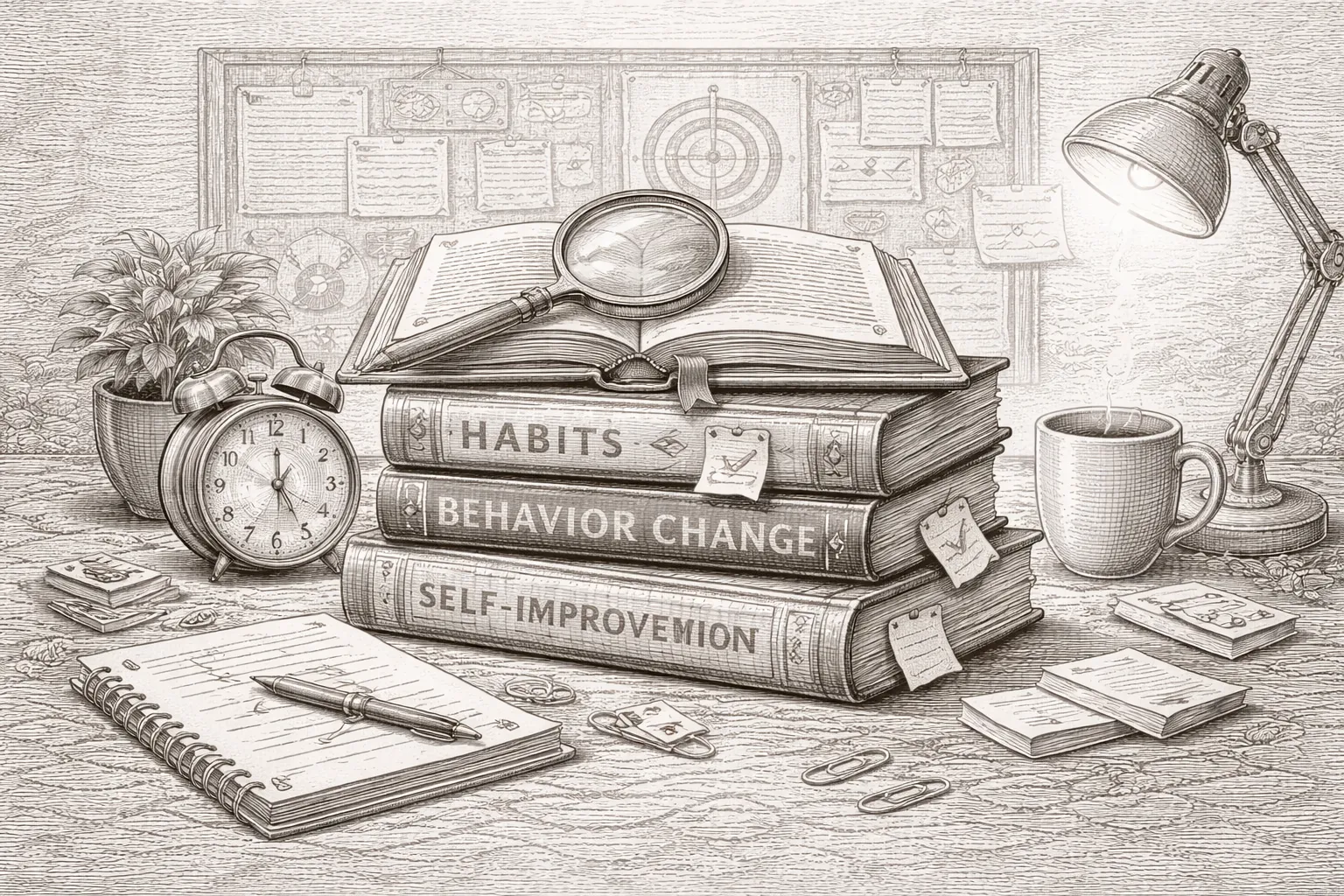
Most behavior change books give you a burst of motivation that fades in two weeks. You read about someone who lost 100 pounds or built a million-dollar business, feel inspired, make dramatic resolutions, fail by Thursday, and feel worse about yourself than before you started.
Books that create lasting change don’t rely on motivation—they teach you how human behavior actually works. They explain why willpower fails, how context shapes decisions, and how to design environments where good behavior is inevitable. After reading them, you don’t need inspiration. You have systems.
Why Most Behavior Change Books Fail
Behavior change books fail because they confuse outcomes with processes. They show you someone who achieved an impressive result and reverse-engineer their story into advice. “They woke up at 5 AM, so you should too.” “They cut out sugar completely, so you should too.” This ignores that everyone’s context, biology, and psychology differ.
The deeper problem: most books treat behavior change as a willpower problem. They assume you’re failing because you’re weak or undisciplined. The real issue is that you’re fighting your environment, your habits, and your brain’s default settings. Willpower is finite. If the system requires constant willpower, it will fail.
Books that work teach you to stop fighting yourself. They show you how to make desired behaviors automatic by changing cues, removing friction, and building identity. They acknowledge that behavior change is hard not because you’re broken, but because human brains are wired to conserve energy and avoid discomfort. Once you understand the mechanics, you can work with your brain instead of against it.
Most importantly, effective behavior change books are honest about failure. They don’t promise that their system works for everyone, always, forever. They teach you to expect setbacks, learn from them, and iterate. The goal isn’t perfection—it’s a slightly better direction over time.
What you actually need from a behavior change book
You need books that teach principles, not protocols. Protocols are specific: “Do X for Y minutes at Z time.” Principles are adaptable: “Make the behavior easier to start than not to start.” Protocols fail when your life changes. Principles work across contexts.
Psychology over inspiration: You need to understand why behavior change is hard—cognitive biases, habits vs. intentions, the gap between knowing and doing. Books should teach the science in accessible language, not just tell motivational stories.
System design over willpower: You need frameworks for designing environments where good behavior is the path of least resistance. If you’re trying to eat healthier, willpower says “resist the cookies.” System design says “don’t buy cookies.” The second approach works.
Identity over goals: Outcome goals (“lose 20 pounds”) create motivation but don’t sustain behavior. Identity-based goals (“become a healthy person”) create sustainable change because actions align with who you are. Books should teach you to shift identity, not just chase outcomes.
Realistic timelines: Behavior change takes months or years, not weeks. Books that promise “21 days to new habits” are lying. Good books give you realistic expectations and teach you to measure progress in direction, not perfection.
How This List Works
Selection criteria:
- I’ve read each book and used the frameworks to change my own behavior
- The books are based on research (psychology, neuroscience, behavioral economics)
- They work for multiple types of behavior change (health, productivity, relationships, money)
- Advice is practical and doesn’t require superhuman discipline
- Books cost under $30 and are widely available
What “behavior change” means: We’re talking about intentional change—building new habits, breaking old ones, overcoming procrastination, managing emotions, improving decision-making. Not therapy-level change (trauma, addiction, mental illness)—those require professional help. But everyday behavior change: exercise regularly, save money, write daily, eat better, reduce phone use.
About affiliate links: This article contains Amazon affiliate links (tag: focusdividend-22). If you purchase through these links, I may earn a small commission at no extra cost to you. I only recommend books I’ve personally read and found valuable for understanding and changing behavior.
Quick Comparison
| Book | Best For | Difficulty | Length | Key Takeaway |
|---|---|---|---|---|
| Atomic Habits | Building systems for any habit | Beginner | 320 pages | Small changes compound into transformation |
| The Power of Habit | Understanding habit loops | Beginner | 371 pages | Change the routine, keep the cue and reward |
| Tiny Habits | Starting when motivation is low | Beginner | 306 pages | Make it so small you can’t say no |
| Thinking, Fast and Slow | Understanding decision-making | Intermediate | 499 pages | Your brain has biases—design around them |
| Switch | Making change when change is hard | Beginner | 305 pages | Direct the Rider, motivate the Elephant, shape the Path |
Start with Atomic Habits if you want a complete system for building any habit. Then read Tiny Habits for the psychology of starting when you’re struggling. Save Thinking, Fast and Slow for when you want deep understanding of why humans make irrational decisions.
The Rankings: Books That Actually Create Lasting Change
1. Atomic Habits by James Clear

Published: 2018 | Pages: 320 | Difficulty: Beginner
What it teaches: Habits are the compound interest of self-improvement. A 1% improvement daily becomes 37x better over a year. Clear’s framework: make habits obvious (cue), attractive (craving), easy (response), and satisfying (reward). The book teaches you to design your environment so good habits are inevitable and bad habits are hard.
Why it works for behavior change: Clear synthesizes decades of habit research into a practical system. Unlike books that just tell you to “be disciplined,” this one gives you specific tactics for each stage of habit formation. After reading, you’ll know exactly how to start a new habit (implementation intention), maintain it (habit stacking), and recover from setbacks (never miss twice). The framework works for any behavior—fitness, productivity, relationships, money.
Key concepts you’ll learn:
-
The Four Laws of Behavior Change: (1) Make it Obvious—design environment so cues for good habits are visible and cues for bad habits are invisible. Want to read more? Put book on your pillow. Want to stop checking phone? Leave it in another room. (2) Make it Attractive—pair habits with things you enjoy. Want to exercise? Only watch your favorite show while on the treadmill. (3) Make it Easy—reduce friction for starting. Want to go to gym? Sleep in your gym clothes. (4) Make it Satisfying—immediate reward after completing. Habit tracker gives visual satisfaction; checking the box feels good even when the workout was hard.
-
Identity-Based Habits: Most people set outcome goals (“I want to lose 20 pounds”) or process goals (“I’ll exercise 3x weekly”). Clear says focus on identity: “I am a healthy person.” When your identity is “healthy person,” the question isn’t “Should I exercise today?” but “What would a healthy person do?” Identity shifts make habits automatic because they align with who you are. The process: decide who you want to be, prove it to yourself through small wins, let identity reinforce behavior in a virtuous cycle.
-
The Plateau of Latent Potential: Behavior change often feels ineffective because results lag behind effort. You work out for a month and don’t see visible changes. You write daily for three months and nobody reads your work. Clear’s metaphor: ice cube at 25°F. You heat it to 26°, 27°, 28°—nothing happens. You keep heating through 29°, 30°, 31°—still ice. Finally at 32° it melts. The change was always happening; you just couldn’t see it. Habits work the same way—months of invisible progress before the breakthrough.
The most valuable chapter:
Chapter 4, “The Man Who Didn’t Look Right,” introduces the Two-Minute Rule: when starting a new habit, make it take less than two minutes to do. Want to read more? “Read one page.” Want to meditate? “Sit down and breathe once.” This sounds absurd—obviously you want to read 30 minutes or meditate 20 minutes. But the Two-Minute Rule removes resistance. You can’t say no to one page. Once you’ve started, continuation is easy. The chapter explains that habits are the entry point, not the endpoint. Master showing up and the rest follows.
Practical application:
Pick one habit you want to build. Use Clear’s framework:
Obvious: Create an implementation intention. “After [current habit], I will [new habit] at [time] in [location].” Example: “After I pour my morning coffee, I will write 100 words at the kitchen table.”
Attractive: Pair it with something you enjoy. “After I write 100 words, I can check social media for 5 minutes.”
Easy: Apply the Two-Minute Rule. “Write 100 words” not “Write for an hour.” Make it so small you can’t say no.
Satisfying: Track it. Use a habit tracker app or paper calendar. Check off each day you complete it. Never miss twice—missing once is forgivable, twice starts a new (bad) habit.
Do this for 66 days (the research-backed average for habit formation). After 66 days, the habit is automatic and you can increase difficulty.
What beginners struggle with in this book:
Clear’s emphasis on “1% better” can feel frustratingly slow if you want dramatic change quickly. The approach is explicitly anti-dramatic—tiny improvements, patient accumulation, trust the process. If you need visible results fast for motivation, this strategy feels inadequate.
Also, the book doesn’t address major psychological barriers—depression, trauma, severe anxiety. Clear’s system assumes you have baseline mental health and just need better systems. If you’re clinically depressed, “make it obvious, attractive, easy, satisfying” won’t be enough. You need therapy first, then Clear’s tactics.
Best read when:
You know what you should do but can’t maintain consistency. Or you’ve tried habit formation before and failed after 2-3 weeks. Or you want to build multiple habits (fitness, productivity, learning) and need one framework that works for all of them. Or you’re the type who needs systematic, research-based approaches rather than inspirational stories.
Real limitation:
The book optimizes for building habits, not breaking them. Clear covers bad habit elimination (invert the Four Laws—make it invisible, unattractive, difficult, unsatisfying), but it’s not as robust as the habit-building section. If your main challenge is quitting something (smoking, drinking, phone addiction), you’ll need to supplement with books specifically about breaking addictions.
Also, some behaviors don’t fit the habit model. One-time decisions (taking a new job, moving cities, ending a relationship) require different frameworks. Clear’s system is for repeated behaviors, not major life choices.
Follow-up reading: After this, read Tiny Habits by BJ Fogg for an alternative approach, or The Power of Habit by Charles Duhigg for deeper neuroscience on how habits form in the brain.
2. The Power of Habit by Charles Duhigg

Published: 2012 | Pages: 371 | Difficulty: Beginner
What it teaches: Habits operate in a neurological loop: cue → routine → reward. Your brain automates repeated behaviors to conserve energy. To change a habit, keep the cue and reward but change the routine. Duhigg explains the neuroscience of habit formation, shows how habits work in individuals, organizations, and societies, and gives you a framework for changing them.
Why it works for behavior change: Duhigg makes habit science accessible through storytelling. You learn about Eugene, who lost his memory but retained habits because they’re stored in the basal ganglia, not the hippocampus. You learn how Target predicts pregnancy through shopping habits. You learn how Alcoholics Anonymous changes drinking habits by substituting routines. The stories make abstract neuroscience concrete and memorable. After reading, you’ll understand why you can’t just “stop” a bad habit through willpower—you need to replace the routine.
Key concepts you’ll learn:
-
The Habit Loop: Every habit has three components. (1) Cue: the trigger that initiates the behavior (time of day, location, emotion, other people, preceding action). (2) Routine: the behavior itself—what you actually do. (3) Reward: the benefit your brain receives, which reinforces the loop. Example: Feeling stressed (cue) → eating cookies (routine) → temporary comfort (reward). Your brain learns: stress = eat cookies = feel better. The loop becomes automatic. To change: identify the cue and reward, experiment with different routines that provide the same reward.
-
Keystone Habits: Some habits create chain reactions that change other behaviors. Duhigg’s research shows that exercise is a keystone habit—people who start exercising tend to eat better, sleep better, work more productively, and smoke less, even when they don’t consciously try to change those things. Exercise creates a sense of “I’m becoming a healthier person,” which influences other decisions. Other keystone habits: making your bed (sets productive tone for the day), eating dinner together as a family (improves communication and kids’ outcomes), tracking spending (leads to saving more).
-
Belief and Community: For habits to permanently change, you need to believe change is possible. Willpower and routine substitution aren’t enough—you need faith that the new pattern will stick. Duhigg shows that belief often comes from group support. This is why AA works—the community reinforces the belief that you can stay sober, especially during crises when individual willpower fails. The implication: for major behavior change (quitting smoking, overcoming anxiety responses, building extreme discipline), you need social support, not just individual tactics.
The most valuable chapter:
Chapter 3, “The Golden Rule of Habit Change,” gives you the practical methodology. To change a habit: (1) Identify the routine you want to change. (2) Experiment with rewards—when you feel the craving, try different routines and note what satisfies the craving. This reveals what reward your brain actually wants. (3) Isolate the cue—track time, location, emotional state, other people, and preceding action when the craving hits. Find the pattern. (4) Make a plan—when [cue], I will [new routine] to get [reward]. The chapter includes worksheets to work through this process.
Practical application:
Pick one habit you want to change. Use Duhigg’s framework:
Identify the routine: What behavior do you want to change? Example: mindless phone scrolling in the evening.
Experiment with rewards: What reward are you seeking? Test different routines. When you feel the urge to check your phone: (a) go for a walk, (b) call a friend, (c) read a book, (d) do push-ups. After each, wait 15 minutes and note if the craving is satisfied. This reveals whether you’re seeking stimulation, social connection, escape from boredom, or something else.
Isolate the cue: Track for a week. When you reach for your phone, note: (1) time, (2) where you are, (3) who else is present, (4) what you just did, (5) how you feel. Find the pattern. Maybe you always check phone at 8 PM (time), on the couch (location), after kids are in bed (preceding action), when feeling tired (emotion).
Make a plan: “When I sit on the couch at 8 PM feeling tired, I will read a book for 20 minutes instead of checking my phone, because I actually want mental downtime not stimulation.”
What beginners struggle with in this book:
Duhigg’s narrative style is engaging but sometimes the lessons get buried in stories. You’ll read 20 pages about how Febreze marketing succeeded through habit formation, and the actionable insight is two paragraphs. Some readers want more tactics, less storytelling.
Also, the book is heavy on explanation and light on implementation. Duhigg tells you how habits work and why they’re hard to change, but doesn’t give you a step-by-step system like Clear does. You understand the science but may still struggle to apply it.
Best read when:
You want to understand why you keep doing things you don’t want to do. Or you’ve tried to change a habit multiple times and it keeps returning—Duhigg explains why (you didn’t change the cue or reward, just tried to suppress the routine). Or you’re fascinated by psychology and neuroscience and want to understand behavior at a deeper level.
Real limitation:
The habit loop framework works best for simple, automatic behaviors (morning routine, snacking, checking email). It works less well for complex behaviors requiring conscious decision-making (career changes, relationship patterns, creative work). Duhigg acknowledges this but doesn’t offer alternative frameworks for non-habitual behaviors.
Also, some habits don’t have clear rewards. Depression-driven behaviors (lying in bed all day, isolating) aren’t providing pleasure or avoiding pain in obvious ways. Duhigg’s framework struggles with these because the “reward” is often just “not feeling worse,” which is harder to substitute.
Follow-up reading: After this, read Atomic Habits for a more tactical system, or Hooked by Nir Eyal for how companies use habit loops to create product addiction.
3. Tiny Habits by BJ Fogg

Published: 2019 | Pages: 306 | Difficulty: Beginner
What it teaches: Behavior happens when Motivation, Ability, and Prompt converge. Make habits tiny (high ability) so motivation doesn’t matter. Anchor new habits to existing ones (reliable prompt). Celebrate immediately after (creates positive emotion that wires the habit). Fogg, a Stanford behavior scientist, spent 20 years researching what actually makes behavior change stick. His answer: make it ridiculously small.
Why it works for behavior change: Fogg’s approach works when you’re struggling—low motivation, high stress, no willpower. Unlike systems that require discipline, Tiny Habits assumes you have no discipline and designs around that. The habits are so small you can’t fail: “After I pour my morning coffee, I will do two push-ups.” Two. Not 20, not a full workout—two. This sounds ineffective until you realize that doing two push-ups builds the identity “I’m someone who exercises.” Once that identity exists, expansion is natural.
Key concepts you’ll learn:
-
The Fogg Behavior Model (B=MAP): Behavior happens when three elements converge at the same moment: Motivation (you want to do it), Ability (you can do it), and Prompt (something reminds you to do it). Most behavior change strategies try to increase motivation (inspiration, goals, rewards). Fogg says make it easier instead—reduce the behavior to its tiniest version so ability is always high. Then focus on the prompt (anchor to existing habit) and celebration (creates emotion that wires the habit). Motivation is unreliable; ability and prompt are controllable.
-
The Celebration Technique: Immediately after doing the tiny behavior, celebrate. Not “reward yourself with ice cream later”—celebrate in the moment. Smile, say “Victory!”, do a fist pump, whatever creates a positive spike of emotion. This seems silly but it’s neurologically crucial. Your brain releases dopamine, which wires the behavior (“I did push-ups, felt good, I should do that again”). Celebration is how Pavlov’s dogs worked—ring bell, get food, brain associates bell with pleasure. You’re doing the same thing: do tiny habit, celebrate, brain associates habit with pleasure.
-
Anchoring: New habits fail because we forget to do them. Fogg’s solution: anchor new habits to existing ones using the format “After I [existing habit], I will [new tiny habit].” Existing habits are automatic and reliable—you always pour morning coffee, always get in car, always brush teeth. Use those as anchors. “After I pour coffee, I will meditate for one breath.” The existing habit becomes the prompt, which solves the “I forgot” problem. After 30-40 reps, the new habit becomes automatic.
The most valuable chapter:
Chapter 2, “Motivation—Focus on Matching,” debunks the myth that you need high motivation to change. Fogg shows that motivation is unreliable—it fluctuates based on sleep, stress, blood sugar, mood. Designing behavior change that requires high motivation means it works when you’re feeling good and fails when you’re not. Instead, match the behavior to your lowest motivation level. If you can do it when stressed, tired, and low-motivation, you can do it always. This reframe is liberating—you’re not lazy for lacking motivation; you’re smart for designing around its absence.
Practical application:
Pick one behavior you want to change. Make it tiny and anchor it:
Make it tiny: Take the desired behavior (exercise, meditate, read, write) and shrink it to the smallest possible version. Not “work out 30 minutes”—“do 2 push-ups.” Not “meditate 20 minutes”—“take 1 conscious breath.” Not “read a book”—“read 1 page.”
Anchor it: Identify an existing habit you do reliably. Write it in the format: “After I [existing habit], I will [tiny new habit].”
- After I pour my morning coffee, I will do 2 push-ups
- After I sit down at my desk, I will take 1 conscious breath
- After I brush my teeth at night, I will read 1 page
Celebrate: Immediately after completing the tiny habit, celebrate. Smile, say “Success!”, feel proud. Do this every single time for the first 30 days.
Do the tiny habit for 30 days without expansion. After it feels automatic, you can gradually increase—3 push-ups, then 5, then a full workout. But don’t increase until the tiny version is effortless.
What beginners struggle with in this book:
The “tiny” part feels too small to matter. People want to see results fast, and doing two push-ups feels like it accomplishes nothing. Fogg’s counter: the push-ups aren’t the point—the identity and automaticity are. But impatient people will skip ahead to harder versions and fail.
Also, celebration feels awkward. Most people won’t fist-pump after two push-ups because it seems ridiculous. But if you skip celebration, you skip the neurological wiring that makes habits stick. You have to be willing to feel silly briefly.
Best read when:
You’re stuck in a motivation rut and can’t seem to start anything. Or you’ve tried big habit changes and failed repeatedly—you need a gentler on-ramp. Or you’re dealing with depression, chronic illness, or low energy and can’t muster energy for traditional habit systems. Or you’re skeptical that small changes matter and need evidence that tiny works.
Real limitation:
Tiny Habits is perfect for starting but less useful for optimization. Once you’ve built the habit and want to improve performance, Fogg’s system doesn’t address that. You’ll do two push-ups forever unless you deliberately choose to expand. The book is about building the foundation, not reaching excellence.
Also, some goals genuinely require scale from the start. Training for a marathon can’t begin with “run for 30 seconds.” Some skills need longer practice sessions to see progress. Fogg’s approach works for building the habit (show up to run daily), but you’ll need to supplement for skill development.
Follow-up reading: After this, read Atomic Habits for scaling up tiny habits into significant behavior change, or Hooked by Nir Eyal for understanding how habit-forming products use Fogg’s model.
4. Thinking, Fast and Slow by Daniel Kahneman

Published: 2011 | Pages: 499 | Difficulty: Intermediate
What it teaches: Your brain has two systems. System 1 is fast, automatic, emotional, and unconscious—it handles most decisions with heuristics and biases. System 2 is slow, deliberate, logical, and effortful—it handles complex reasoning but gets tired. Most behavior change fails because you’re using System 2 to fight System 1, and System 1 always wins when you’re tired or stressed. Kahneman, a Nobel Prize-winning psychologist, explains the cognitive biases that sabotage behavior change and how to work with them.
Why it works for behavior change: This isn’t a traditional behavior change book—it’s about decision-making and cognitive bias. But understanding how your brain actually works is crucial for lasting change. After reading, you’ll stop blaming yourself for irrational decisions and start designing around your irrationality. You’ll understand why you procrastinate (present bias), why you quit diets (loss aversion), why you buy things you don’t need (anchoring), and why you can’t predict what will make you happy (affective forecasting errors).
Key concepts you’ll learn:
-
System 1 vs. System 2: System 1 operates automatically and quickly, with little effort and no sense of voluntary control. It’s associative, emotional, and fast. Examples: detect that one object is more distant, understand simple sentences, drive on an empty road, make a “disgust face” when seeing something gross. System 2 allocates attention to effortful mental activities that demand it, including complex computations. Examples: focus on a specific person in a crowd, maintain faster walking speed than normal, fill out a tax form, check validity of a complex logical argument. System 2 believes it’s in charge, but System 1 actually makes most decisions. System 2 only activates for novel or complex situations.
-
Cognitive Biases That Sabotage Change: Kahneman catalogs dozens of biases. Key ones for behavior change: (1) Availability heuristic—you judge probability by how easily examples come to mind, so you overestimate risks you’ve seen recently (plane crashes) and underestimate abstract ones (heart disease). (2) Anchoring—the first number you see influences your judgment, even if irrelevant. (3) Sunk cost fallacy—you continue bad investments because you’ve already invested time/money. (4) Planning fallacy—you underestimate how long tasks will take and overestimate what you can accomplish. (5) Loss aversion—losing $100 feels worse than gaining $100 feels good, so you avoid changes that might involve loss.
-
What You See Is All There Is (WYSIATI): System 1 makes coherent stories from limited information and doesn’t acknowledge what it doesn’t know. If you’re deciding whether to eat healthy, System 1 focuses on “ice cream tastes good” and ignores long-term health consequences because they’re abstract and far away. WYSIATI means you make confident decisions based on incomplete information. The implication: behavior change requires making long-term consequences concrete and immediate consequences less salient. Put pictures of your health goals on the fridge, not just rely on abstract “I should be healthy.”
The most valuable chapter:
Chapter 24, “The Illusion of Validity,” explains why expert predictions are no better than random chance in many domains, yet experts remain confident. Kahneman shows that humans are wired to create causal narratives even from random data. For behavior change, this means you’ll invent explanations for why you failed (“I don’t have discipline”) when the real cause is systemic (the environment made bad choices easy). The chapter teaches you to distrust your explanatory narratives and focus on changing systems instead.
Practical application:
Identify the cognitive biases sabotaging your behavior change:
Present bias: You overvalue immediate rewards and undervalue future ones. Fix: make future consequences immediate. Want to save money? Automate transfers to savings on payday (removing the decision). Want to exercise? Pre-commit by signing up for morning class and telling a friend (creates immediate social cost if you skip).
Loss aversion: You avoid change because potential losses loom larger than gains. Fix: reframe. Instead of “I’m giving up dessert” (loss), say “I’m gaining energy and health” (gain). Or use loss aversion productively—bet money with a friend that you’ll work out 3x weekly. Fear of losing money motivates more than desire to gain fitness.
Planning fallacy: You think you’ll have more time/energy than you actually will. Fix: Halve your estimates. If you think you can work out 5x weekly, commit to 2-3x. Build from smaller sustainable base rather than failing at ambitious plan.
Availability heuristic: Recent vivid examples dominate your thinking. Fix: Track data. Don’t rely on memory of “how often” you do something—write it down. Most people overestimate good behaviors and underestimate bad ones.
What beginners struggle with in this book:
It’s long (500 pages), dense, and academic. Kahneman writes for peers, not general audience. Some chapters are fascinating (the section on happiness is life-changing), others are technical studies of statistical reasoning. You can skim the technical parts, but the book requires sustained focus.
Also, it’s primarily descriptive, not prescriptive. Kahneman tells you how your brain works and why you make mistakes, but doesn’t give you a step-by-step behavior change system. You have to extract implications yourself.
Best read when:
You’re interested in why humans are irrational and want deep understanding. Or you’ve tried behavior change and want to understand why you keep self-sabotaging. Or you’re in a field that requires good decision-making (investing, management, medicine, policy) and want to reduce bias. Don’t read this as your first behavior change book—read it after you’ve tried simpler systems and want to understand the psychology underneath.
Real limitation:
Knowing your biases doesn’t eliminate them. Kahneman himself admits he still falls for cognitive biases despite spending his career studying them. The book gives you awareness, not immunity. You’ll need to pair knowledge with system design (Atomic Habits, Tiny Habits) to actually change behavior.
Also, the book is depressing if you read it wrong. You’ll finish thinking “I’m hopelessly irrational and can’t trust my own judgment.” The correct takeaway is “I’m systematically irrational in predictable ways, so I can design around it.” But the book doesn’t emphasize the hopeful interpretation.
Follow-up reading: After this, read Nudge by Richard Thaler and Cass Sunstein for how to apply behavioral economics to decision-making, or Predictably Irrational by Dan Ariely for more accessible coverage of similar topics.
5. Switch by Chip Heath and Dan Heath

Published: 2010 | Pages: 305 | Difficulty: Beginner
What it teaches: Change is hard because your rational mind and emotional mind often disagree. The Heaths use the metaphor: you’re a Rider (rational mind) on an Elephant (emotional mind) traveling a Path (the environment). The Rider can’t force the Elephant to go where it doesn’t want to go—the Elephant is bigger and stronger. Lasting change requires three things: Direct the Rider (provide clear direction), Motivate the Elephant (appeal to emotion), and Shape the Path (make the environment easy).
Why it works for behavior change: Switch synthesizes research from psychology, sociology, and organizational change into a practical framework. The book is full of case studies—how someone got an entire town to recycle more, how someone saved marriages, how someone transformed a failing company. Each story illustrates the framework in action. After reading, you’ll understand why logical arguments fail (you’re only directing the Rider) and why emotional appeals fade (the Elephant gets tired). You need all three elements.
Key concepts you’ll learn:
-
Direct the Rider: The Rider is your rational, analytical mind. It’s good at planning and analysis but prone to overthinking and analysis paralysis. To direct the Rider: (1) Find the bright spots—study what’s already working and do more of it, rather than focusing on problems. If you ate healthy on Tuesday, what was different about Tuesday? Replicate that. (2) Script the critical moves—give yourself specific behaviors, not vague goals. Not “eat healthier”—“eat a salad for lunch Monday-Friday.” Ambiguity exhausts the Rider. (3) Point to the destination—create a vivid vision of what success looks like so the Rider knows where to go.
-
Motivate the Elephant: The Elephant is your emotional mind. It’s powerful and provides energy for change, but it’s also lazy and seeks comfort. To motivate the Elephant: (1) Find the feeling—analytical arguments don’t move the Elephant. Show vivid examples, tell stories, create experiences that evoke emotion. If you want to exercise, don’t list health benefits—imagine how you’ll feel running with your kids. (2) Shrink the change—big changes overwhelm the Elephant. Make it small enough that the Elephant thinks “I can do this.” (3) Grow your people—build identity. When people see themselves as “I’m a runner” or “I’m someone who saves money,” the Elephant wants to act consistently with that identity.
-
Shape the Path: Even a motivated Rider on a willing Elephant will fail if the Path is full of obstacles. Shape the environment: (1) Tweak the environment—make good behaviors easy and bad behaviors hard. Want to eat less junk food? Don’t buy it. Want to write more? Disconnect internet before starting. (2) Build habits—create action triggers. “After I pour coffee, I will write for 10 minutes.” Habits put the Elephant on autopilot so you don’t need constant motivation. (3) Rally the herd—behavior is contagious. Surround yourself with people doing the behavior you want. Join a running club, a writing group, a finance forum.
The most valuable chapter:
Chapter 5, “Find the Feeling,” explains why logical arguments don’t create behavior change. The Heaths tell the story of a manager trying to reduce costs. He presented data showing the company bought 424 different types of gloves, each from different suppliers, at different prices. The data didn’t move anyone. Then he collected one of each type of glove and piled them on the conference table with price tags. Executives saw the physical waste and immediately authorized changes. The lesson: emotion drives behavior, not analysis. To change the Elephant, show, don’t tell.
Practical application:
Pick one behavior change you’re struggling with. Apply the framework:
Direct the Rider:
- Find a bright spot: When have you successfully done this behavior? What was different? If you never have, who has? Study them.
- Script the critical move: Write specific behaviors. “Every Monday, Wednesday, Friday at 6 AM, I will go to the gym and follow this 30-minute routine.”
- Point to destination: Visualize success vividly. “In 6 months, I’ll have energy to play with my kids without getting tired.”
Motivate the Elephant:
- Find the feeling: Connect emotionally. Don’t think about “losing weight”—imagine fitting in your favorite jeans again, or the pride of your kids seeing you healthy.
- Shrink the change: If 3x weekly gym feels overwhelming, start with 1x. Build confidence before expanding.
- Grow your people: Tell people “I’m becoming a healthy person.” Act like that person would act.
Shape the Path:
- Tweak environment: Put gym clothes next to bed. Remove junk food from house. Make good choice the easy choice.
- Build habits: “After I wake up, I will put on gym clothes immediately.” Automate the decision.
- Rally the herd: Join a gym class, find a workout partner, follow fitness people on social media. Make your environment pro-health.
What beginners struggle with in this book:
The Rider/Elephant/Path metaphor is helpful but sometimes the Heaths stretch it too far. Not every behavior problem fits neatly into “direct,” “motivate,” or “shape.” Some situations are more complex and require frameworks the book doesn’t provide.
Also, the book focuses on one-time changes (launching a new program, making a big decision) more than building daily habits. The framework works for both, but the examples are often organizational or big life changes. If you’re trying to build small daily habits, Atomic Habits or Tiny Habits are more directly applicable.
Best read when:
You know what you should do but keep not doing it, and logical arguments aren’t working. Or you’re trying to create change in others (kids, spouse, team) and need to understand how to motivate people who resist. Or you’ve tried willpower-based approaches and failed—Switch teaches you that willpower isn’t the answer, environmental design is.
Real limitation:
The Rider/Elephant split oversimplifies how the brain works. Kahneman’s System 1/System 2 model is more accurate neuroscientifically. But the Heaths intentionally chose a metaphor over precision because it’s memorable and actionable. If you want accuracy, read Kahneman. If you want a simple framework you can remember in the moment, read Switch.
Also, some changes genuinely require Rider control—learning complex skills, making strategic decisions, overcoming trauma. The Elephant wants comfort and familiarity. Growth often requires discomfort that the Elephant resists. The book under-addresses how to handle necessary discomfort.
Follow-up reading: After this, read Nudge by Thaler and Sunstein for more on environmental design, or The Catalyst by Jonah Berger for a different framework on creating change.
Honorable Mentions Worth Your Time
The Willpower Instinct by Kelly McGonigal

Why it didn’t make top 5: Focused specifically on willpower and self-control, which makes it narrower than the other books. McGonigal teaches you to strengthen willpower like a muscle (sleep, meditation, exercise, glucose management), but the premise that willpower is the solution contradicts the environmental design approach that works better for most people.
Why it’s still valuable: If you’ve eliminated environmental obstacles and still struggle with self-control in the moment—resisting temptation, staying focused, following through—this book helps. McGonigal’s strategies for managing stress-induced decisions and emotional eating are particularly strong. The neuroscience of why willpower fails is illuminating.
Best for: People who need willpower tactics for specific situations (resisting cravings, staying focused during work, avoiding impulse purchases) rather than building habits.
Hooked by Nir Eyal

Why it didn’t make top 5: Written for product designers, not individuals trying to change their own behavior. Eyal explains how apps like Instagram and Twitter create user habits through the Hook Model (Trigger → Action → Variable Reward → Investment). The framework works in reverse—you can unhook yourself from addictive products—but that’s not the book’s primary purpose.
Why it’s still valuable: Understanding how tech companies manipulate your behavior helps you resist. If you’re trying to quit social media, reduce phone use, or stop doomscrolling, Hooked explains the psychology being weaponized against you. Once you see the mechanics, you can design counter-measures.
Best for: People struggling with tech addiction or anyone interested in behavioral design and product psychology.
Mindset by Carol Dweck

Why it didn’t make top 5: The core idea—growth mindset (I can improve) vs. fixed mindset (my abilities are set)—is powerful but the book is repetitive. Dweck makes the same point about praising effort instead of talent across different domains (sports, business, relationships, parenting). The insight is valuable but stretched thin over 250 pages.
Why it’s still valuable: Mindset shapes how you respond to failure, which determines whether behavior change sticks. Fixed mindset says “I failed, therefore I can’t do this.” Growth mindset says “I failed, therefore I need more practice.” The latter makes you persist through the difficult middle phase of behavior change where most people quit.
Best for: People who give up quickly after setbacks, or anyone working with kids/students and wanting to instill resilience.
Books to Skip (And Why)
The Secret by Rhonda Byrne
Why it’s harmful: Promotes “law of attraction”—the pseudoscientific idea that positive thinking manifests desired outcomes. This is not how behavior change works. Positive thinking without action accomplishes nothing. Worse, it blames people for their circumstances (you’re poor/sick/unhappy because you’re not thinking positively enough), which is cruel and wrong.
Better alternative: Read Atomic Habits for evidence-based behavior change or Thinking, Fast and Slow for actual psychology of how your mind works.
The Magic of Thinking Big by David Schwartz
Why it fails: Classic self-help book from 1959 full of vague platitudes. “Believe you can succeed and you will!” “Think big!” The advice is generic, unactionable, and not backed by research. Reading it might make you feel momentarily inspired, but you won’t change any behaviors because it doesn’t teach you how.
Better alternative: Read Switch for concrete frameworks on creating change or Tiny Habits for practical tactics.
How to Read These Books Effectively
Reading order for complete beginners
-
Start with: Atomic Habits - Most comprehensive system for building any habit. Gives you the complete framework before diving into specialized topics.
-
Then read: Tiny Habits - Addresses the biggest obstacle for beginners: starting when motivation is low. Fogg’s approach complements Clear’s.
-
Finally: Switch - Adds environmental design and emotional motivation to the habit systems you’ve already learned.
Save The Power of Habit for deeper understanding of habit neuroscience after you’ve built some habits. Save Thinking, Fast and Slow for when you want to understand why you make irrational decisions.
Reading strategies that actually work
Read with a specific behavior in mind: Don’t read abstractly—choose one behavior you want to change before starting. As you read, constantly ask “How does this apply to my specific situation?” Take notes on tactics you’ll implement. Behavior change books are useless as entertainment; they’re textbooks for your life.
Implement immediately, not after finishing: When you learn a new technique (Two-Minute Rule, Celebration, Habit Stacking), implement it that day. Don’t wait to finish the book. Most people read entirely, intend to implement, forget what they read, and change nothing. Better to read one chapter, implement one technique, and keep that technique even if you never finish the book.
Test one idea for 30 days before adding more: Each book contains dozens of techniques. Don’t try them all at once. Pick one (habit stacking, celebration after tiny habits, scripting critical moves), commit to 30 days, evaluate results. Then add another technique. Trying everything simultaneously guarantees failure.
Common reading mistakes
Reading multiple behavior change books simultaneously: You read Atomic Habits, Tiny Habits, and The Power of Habit at the same time, confuse the frameworks, implement nothing. Better to read one book deeply, implement its system for 90 days, then read the next.
Collecting techniques but not using them: You highlight great ideas, take notes, and feel productive. Six months later, your highlights sit in a notebook and your behavior hasn’t changed. Highlighting isn’t implementation. If you didn’t change a behavior, you didn’t read the book—you just moved your eyes across pages.
Expecting overnight transformation: You read Atomic Habits on Monday, start five new habits Tuesday, fail by Thursday, and declare the book doesn’t work. Behavior change takes weeks or months. The book works if you implement it correctly and give it time. Most people quit before the system has a chance to work.
Pairing Books with Other Resources
Atomic Habits + Habit tracking apps
Clear’s framework requires tracking. Use apps: Streaks, Habitica, Done, or Loop Habit Tracker. After reading, identify your 3-5 keystone habits (exercise, reading, writing, meditation, whatever matters for your goals). Track daily. Clear says “never miss twice”—missing once is acceptable, twice is forming a new bad habit. The app makes this visible.
Tiny Habits + Accountability partner
Fogg’s system works better with social support. After reading, find someone also trying to build habits. Text each other daily: “Did my 2 push-ups ✓” The accountability isn’t pressure—it’s celebration. When both people succeed, you’re celebrating together. When one fails, the other reminds them “just start again tomorrow, no guilt.”
Thinking, Fast and Slow + Decision journal
Kahneman teaches you about cognitive biases. Pair this with a decision journal—before making significant decisions, write down: (1) what you’re deciding, (2) what you expect will happen, (3) why you believe that, (4) what biases might be affecting you. Six months later, review. You’ll see where your predictions were wrong and which biases you fall for repeatedly.
Situational Recommendations
| Your Situation | Start With | Why |
|---|---|---|
| Can’t stay consistent with habits | Atomic Habits | Complete system for building habits that stick |
| Motivation is low, can’t start | Tiny Habits | Makes starting so easy you can’t say no |
| Keep self-sabotaging | Thinking, Fast and Slow | Understand the biases causing self-sabotage |
| Know what to do, don’t do it | Switch | Addresses the Rider/Elephant/Path disconnect |
| Want to understand how habits work | The Power of Habit | Best neuroscience explanation |
| Trying to create change in others | Switch | Framework for motivating people who resist |
| Struggling with willpower | The Willpower Instinct | Specific willpower tactics |
| Tech/phone addiction | Hooked | Understand how products manipulate behavior |
Frequently Asked Questions
Q: How long does behavior change actually take?
Research shows habits take 18-254 days to form, with an average of 66 days. Simple behaviors (drinking water after waking) form faster. Complex behaviors (exercising daily) take longer. The “21 days” myth is false. Expect 2-3 months minimum before a habit feels automatic, 6-12 months before it’s truly ingrained.
Q: Can I change multiple habits at once?
Yes, but don’t change too many. Research suggests 1-3 habits simultaneously is sustainable. More than that and you’ll fail at all of them. Start with one habit for 30 days. Once it’s automatic, add a second. Build slowly rather than crash and burn.
Q: What if I’ve tried these strategies and still failed?
First, did you actually implement or just read about implementing? Most people fail because they didn’t do the work, not because the strategies don’t work. Second, some behavior change requires professional help—therapy for trauma, medical support for addiction, medication for ADHD. Books are powerful but not sufficient for clinical-level issues.
Q: Which book should I read if I only read one?
Atomic Habits. It’s the most comprehensive, research-based, and actionable system for building any habit. You’ll get 80% of the value from that one book.
Q: Do these books work for breaking bad habits or just building good ones?
All address both, but Atomic Habits and The Power of Habit are best for breaking bad habits. The key insight: you can’t just stop a bad habit through willpower—you need to replace the routine while keeping the cue and reward.
What to Do After Reading
If you read Atomic Habits:
-
Immediate next step: Pick one habit to build. Use the Four Laws to design it: Obvious (implementation intention), Attractive (temptation bundling), Easy (Two-Minute Rule), Satisfying (habit tracker).
-
Within 30 days: Track the habit daily. Never miss twice. After 30 days of consistency, evaluate. Is it becoming automatic? If yes, add a second habit. If no, make it easier.
-
Follow-up resource: Subscribe to James Clear’s 3-2-1 newsletter for weekly habit tactics. Use a habit tracker app (Streaks, Habitica, Done).
If you read The Power of Habit:
-
Immediate next step: Identify one habit you want to change. Use Duhigg’s worksheet (in the appendix) to identify the cue, routine, and reward. Experiment with alternative routines.
-
Within 30 days: Implement your planned routine substitution. When [cue], I will [new routine] to get [reward]. Track success rate. Adjust if the new routine doesn’t satisfy the reward.
-
Follow-up resource: Read Atomic Habits for tactical implementation of the habit loop framework.
If you read Tiny Habits:
-
Immediate next step: Pick one behavior. Make it tiny. Anchor it to an existing habit. “After I [existing habit], I will [tiny new behavior].”
-
Within 30 days: Do the tiny habit daily and celebrate immediately after. Don’t expand until it feels effortless. Track your streak.
-
Follow-up resource: Join Tiny Habits Academy or BJ Fogg’s email list for ongoing support. Find an accountability partner.
If you read Thinking, Fast and Slow:
-
Immediate next step: Start a decision journal. Before major decisions, write down your prediction and reasoning. Six months later, review your accuracy.
-
Within 30 days: Identify which cognitive biases you fall for most often (availability heuristic, sunk cost, planning fallacy). Design specific systems to counteract them.
-
Follow-up resource: Read Nudge by Thaler and Sunstein for applying behavioral economics to your own life.
If you read Switch:
-
Immediate next step: Pick one change you’re struggling with. Apply the framework: (1) Direct the Rider—script critical moves, (2) Motivate the Elephant—find the feeling, (3) Shape the Path—tweak environment.
-
Within 30 days: Implement all three elements simultaneously. Change is most likely when Rider, Elephant, and Path are aligned.
-
Follow-up resource: Pair with Atomic Habits for habit-building tactics or The Power of Habit for deeper neuroscience.
Who This Reading List Is (and Isn’t) For
Good fit if you:
- Want to build new habits (exercise, reading, writing, meditating) or break old ones (phone use, eating, procrastination)
- Understand intellectually what to do but can’t maintain consistency—you need systems, not knowledge
- Are willing to implement what you read—behavior change books only work through action, not passive reading
- Want research-based approaches, not motivational fluff or unproven life hacks
Skip this list if:
- You’re dealing with clinical issues (addiction, eating disorders, severe depression, trauma)—you need therapy, not self-help books
- You want quick fixes or overnight transformation—behavior change takes months or years
- You’re not willing to track, measure, or follow systems—these books require deliberate implementation
- You’re looking for inspiration or entertainment—these are practical textbooks, not motivational reads
By personality type:
-
Analytical types: Start with Thinking, Fast and Slow for deep understanding, then Atomic Habits for systematic implementation.
-
Action-oriented types: Start with Tiny Habits—most practical and immediate, less theory.
-
People who need emotional connection: Start with Switch for stories and metaphors, then The Power of Habit for more narratives.
-
Chronic self-saboteurs: Start with Thinking, Fast and Slow to understand your biases, then Atomic Habits to design around them.
The Takeaway
If you only read one book, read Atomic Habits. It’s the most comprehensive, actionable, and research-based system for changing any behavior. The Four Laws (obvious, attractive, easy, satisfying) work for building good habits and breaking bad ones.
If you read all five, go in this order: Atomic Habits → Tiny Habits → The Power of Habit → Switch → Thinking, Fast and Slow. You’ll learn a complete system (Atomic Habits), tactics for starting small (Tiny Habits), the neuroscience underneath (Power of Habit), environmental design (Switch), and cognitive biases to avoid (Thinking Fast and Slow).
The most important shift: stop relying on motivation and willpower. They’re unreliable and finite. Instead, design systems where good behavior is easier than bad behavior. Change your environment, shrink the behavior until it’s effortless, and build identity around who you want to become. That’s what works. Everything else is just feeling good about yourself while nothing changes.